Bad race day? Top 10 reasons you might have failed
Discover the top 10 reasons runners fail on race day — and how to fix pacing, fuelling, and recovery before the next one.

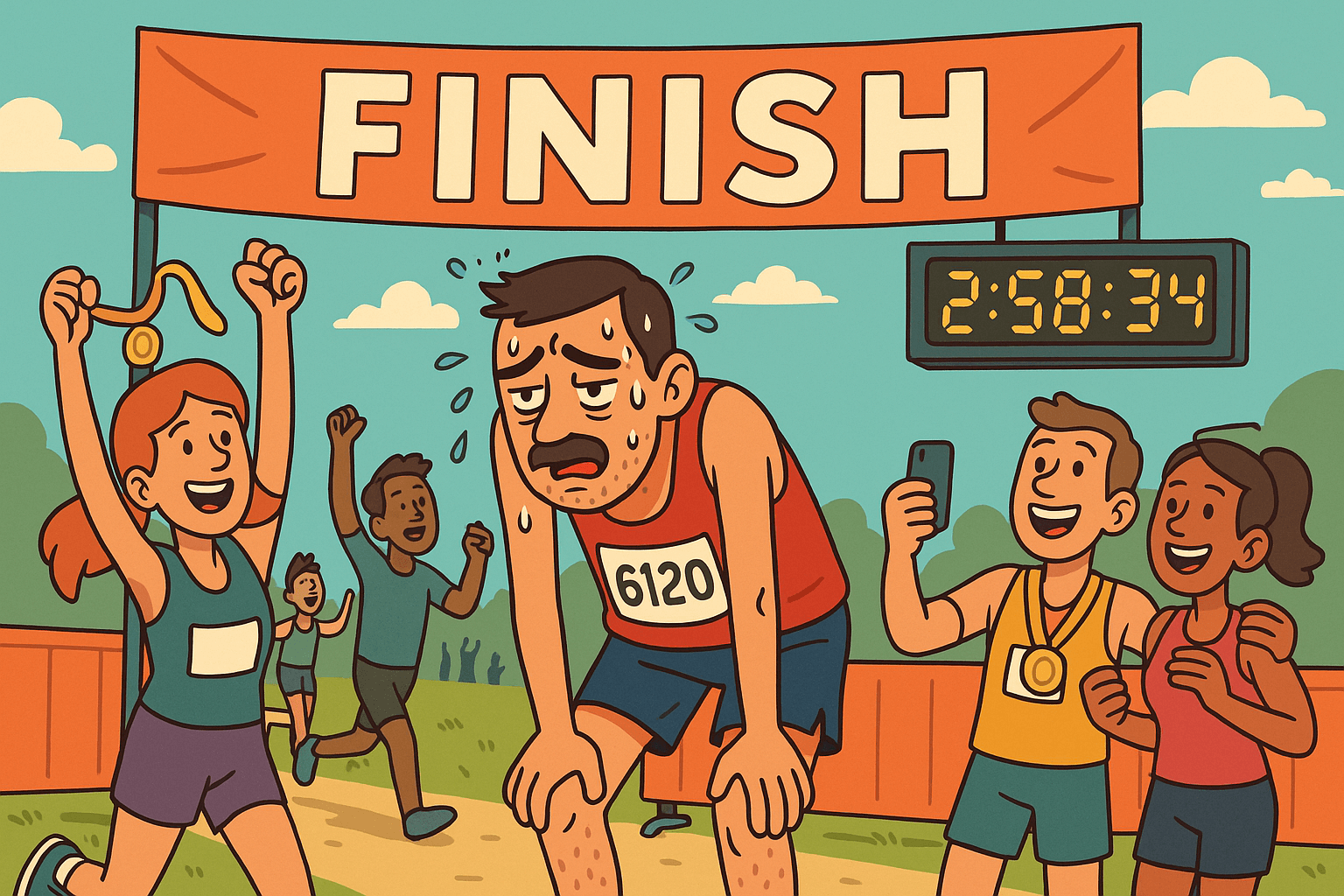
You trained for months, nailed every session, perfected your carb load, and still blew up halfway through. From pacing ego and mystery viruses to the ancient art of under-fuelling, here’s why your legs may have betrayed you — and how to stop it happening again.
1. You started too fast
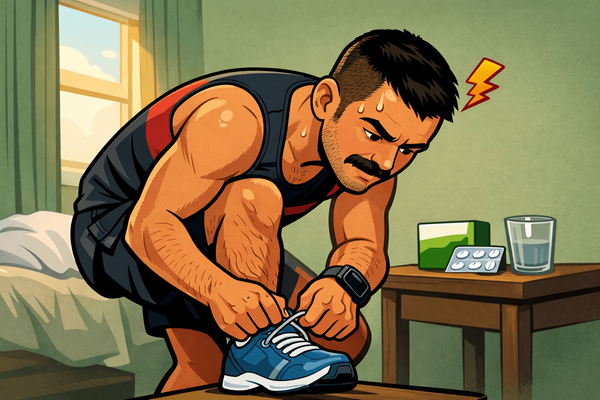
The start line is a dangerous cocktail of adrenaline, music, and collective delusion. You’ll look down at your watch, see a pace you’ve never held in training, and think, “It feels easy!”.
It feels easy because your body’s flooded with adrenaline — the fight-or-flight hormone that temporarily hides fatigue and makes you feel superhuman. But those first kilometres set off a chain reaction inside your muscles that no amount of hype can undo.
What happens in your body when you start a race too fast?
Fast starts push you into anaerobic glycolysis — the process your muscles use to make energy quickly when oxygen delivery can’t keep up with demand. It’s efficient for sprints, but costly for long distances. You burn through glycogen (your stored carbohydrate fuel) at double speed and produce lactate and hydrogen ions as by-products.
Lactate itself isn’t the villain — your body can recycle it for energy — but the hydrogen ions that come with it make the muscle environment more acidic. That acidity interferes with how muscles contract, so your legs start to feel heavy, coordination drops, and your effort skyrockets.
That “effort” feeling is measured as RPE — Rate of Perceived Exertion — basically how hard something feels on a 1-to-10 scale. Go out too fast, and your RPE climbs too early. You might still be running at a decent pace, but your brain thinks you’re sprinting up Everest and starts sending “slow down or die” signals long before halfway.
By burning glycogen fast and building up acidity, you’re sabotaging your ability to stay in your aerobic, oxygen-friendly zone — the one that keeps you steady for the long haul. Once your body shifts into anaerobic mode early, it’s hard to switch back. Heart rate spikes, breathing feels ragged, and even a small hill can feel like a personal attack.
You’ve effectively taken out an overdraft on your energy account, and the interest hits around kilometre 15 in the form of jelly legs, nausea, and the creeping dread that your race plan just became a survival mission.
How to fix it
Make the first third feel borderline boring. If your goal pace is 5:00 per km, start 5:05–5:10, settle, then tighten in the second half. Practise this in long runs and tune ups so race day is muscle memory, not optimism.
2. You messed up your fuel
Runners love to say “nutrition is the fourth discipline” — but we usually treat it like a takeaway menu: panic order, regret instantly. Whether you under-fuelled and hit the wall, or over-did it and visited every portaloo on the course, both mistakes come down to the same thing: your muscles and gut didn’t get the memo.
You ran on empty
Your muscles store carbohydrate as glycogen, the body’s premium, high-octane fuel. In endurance races, you burn through roughly 60–90 grams of carbohydrate per hour — far more than your body can absorb without help. When glycogen runs low, your body switches to burning fat, which sounds virtuous but is a terrible idea mid-race.
Fat is slow fuel; it takes more oxygen to burn. That means your aerobic system (the oxygen-based energy pathway) can’t keep pace, and your brain steps in to stop you from imploding. It does this by making everything feel awful — legs heavy, pace impossible, life choices questionable. This is the infamous “wall.”
How to fix it
Carb loading isn’t a single night of pasta — it’s a 36–48-hour operation. You’re topping up glycogen slowly, not cramming it.
- Before the race: 7–10 grams of carbs per kilo of body weight per day. For an 80-kg runner, that’s 560–800 grams — yes, an alarming amount. Spread it out: rice, potatoes, bread, fruit juice, even Haribo if you must.
- During the race: Start fuelling early — ideally before you feel tired. Your gut can absorb about 60 grams of glucose per hour, or up to 90 grams if you mix glucose and fructose (check your chosen carb’s ingredients).
Train your gut to handle this in long runs. It’s a muscle, not a mystery.
You over-did it
Pre-race, many runners panic-eat as if famine is scheduled for mile one. The problem isn’t carbs — it’s timing and composition. High-fat or high-fibre meals slow gastric emptying, meaning food just sits there while you run. Blood flow diverts from your digestive system to your working muscles, and your gut essentially says “You’re on your own.”, which may result in sloshing, bloating, cramps, nausea — and a porta-loo PR no one wants.
As well as ove-doing it pre-race, if you take on gels faster than your stomach can process them during the race, sugar piles up in your gut. The water it draws in to dilute itself makes you feel bloated and desperate for either a burp or divine intervention.
How to fix it
- Day before: Keep carbs high, but cut fibre and fat. This is not salad day.
- Morning of: Stick to low-fibre, low-fat, high-carb breakfast — white toast, jam, banana, or rice cakes. Avoid “trying something new” unless you like chaos.
- During race: Space gels or chews evenly and chase with small sips of water. If it’s sloshing, you’re drinking too much.
3. You forgot the salt
Sweat isn’t just water — it’s a mineral cocktail of sodium, potassium, chloride, and magnesium. When you lose too much sodium, your body’s electrical system starts short-circuiting.
Sodium is the mineral that helps nerve signals reach your muscles. Every time a muscle contracts, sodium and potassium swap places across cell membranes. Lose too much sodium through sweat without replacing it, and that electrical signal gets weaker. Your brain keeps trying to send “run faster,” but your calves have gone on strike.
Meanwhile, drinking too much plain water makes things worse. It dilutes blood sodium levels, which not only causes cramps and fatigue but, in extreme cases, can lead to hyponatremia — dangerously low sodium.
Cramps are partly electrical misfires, partly fatigue. When your muscles are tired and your sodium balance is off, the nerve signals that control contraction go haywire. Think of it as static on a radio: the message is there, but it’s scrambled.
How to fix it
- Before the race: Add a little extra salt to your meals, or sip an electrolyte drink.
- During the race: Replace around 300–600 mg of sodium per hour — roughly one electrolyte tablet every 5–10k, depending on sweat rate.
- After the race: Keep drinking until your pee is pale yellow. Dark amber is not a personality trait.
4. Racing with or after an illness
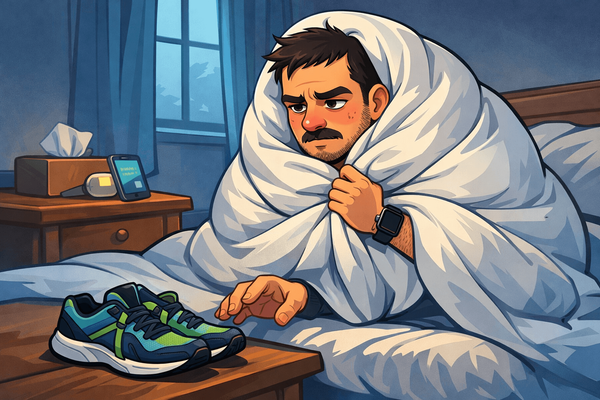
When you fight an infection, immune cells run on glucose, which your body mostly gets by breaking down stored carbohydrates (glycogen) in your liver and muscles. Fever and inflammation also raise your resting energy needs, so you burn through fuel even while lying on the sofa. So while you might feel “fine” two days later, your body is still rebuilding glycogen and rebalancing fluids and electrolytes. That is why a normal easy run suddenly feels like wading through custard.
Lower muscle and liver glycogen means your brain clamps pace early to protect you. Add mild dehydration from being sick and you get higher heart rate for the same pace, earlier fatigue, and a sudden loss of top gear.
How to fix it
In an ideal world, you push back the race. If you feel well enough to run on race day, mentally prepare for a tougher-than-usual run and don’t expect any PBs. Go out and enjoy it without the pressure.
5. The weather tried to kill you
You can train for months, but you can’t outsmart physics. Temperature, humidity, wind, and cold all change how hard your body works for the same pace.
- When it’s hot, your body shunts blood to the skin to cool you down. That means less blood (and oxygen) reaches your muscles, and your heart rate climbs to compensate. Sweat helps, but sweating costs you fluids and electrolytes, reducing plasma volume — the liquid part of your blood — so your heart has to work even harder.
- When it’s humid, sweat can’t evaporate properly, so you overheat faster.
- When it’s windy, every stride becomes resistance training.
- When it’s cold, blood vessels constrict, slowing oxygen delivery and making muscles feel wooden.
How to fix it
- Heat: Slow your pace by 10–15 seconds per km. Pour water over yourself, not just into yourself.
- Wind: Tuck behind other runners — legal drafting is free speed.
- Cold: Warm up longer, keep gloves on, and don’t panic if your first kilometre feels awful.
Everyone else is suffering too. The trick is to suffer smarter.
6. You didn’t sleep
You can carbo-load like an Olympian, but if you’ve been sleeping like a raccoon in a disco, your race will feel twice as hard.
Sleep is when your body restores glycogen in muscles, repairs tissue damage, and releases growth hormone — all critical for recovery. Miss a few nights and your cortisol (stress hormone) stays high, which stops glycogen from storing properly and messes with how your body regulates blood sugar.
You’ll wake up wired but tired — alert enough to race, too depleted to perform. Even one bad week of sleep increases perceived effort and reduces time to exhaustion.
How to fix it
- Prioritise the two nights before race day, not just the last one.
- Go to bed at a consistent time and skip doom-scrolling.
- If nerves keep you up the night before, lie still and rest — your body still recovers even if your brain won’t shut up.
7. You trained hard, but not smart
Runners are experts at mistaking suffering for progress. But training is a balance of stress and recovery — not a punishment ritual.
When you train, you create microscopic damage in your muscles. Recovery time is when they rebuild stronger. Skip recovery, and you just accumulate fatigue — no supercompensation, just a slow, creeping tiredness that masquerades as “mental weakness.”
Most endurance athletes perform best on an 80/20 rule: 80% easy, 20% hard. “Easy” means conversational pace — low heart rate, aerobic work that trains your mitochondria (the little energy factories in your cells) to use oxygen efficiently. “Hard” means actual, structured effort: intervals, tempo runs, long runs with purpose.
If every run feels hard, you’re not training — you’re digging.
How to fix it
- Slow down your easy runs.
- Keep your hard sessions truly hard.
- Sleep. Eat. Repeat.
8. You lost your mind
Every runner meets a wall — not the glycogen one, the psychological one. That moment when your brain screams, “You’re dying!” and your body replies, “Are we?”
Your brain acts like a protective governor. When it senses rising effort or overheating, it pre-emptively dials down muscle activation to prevent collapse. It’s not weakness; it’s survival instinct.
This perception of effort — RPE again — is shaped by fatigue signals, body temperature, breathing rate, and your emotions. The fitter you are, the better your brain learns that discomfort isn’t dangerous.
Studies show that mental training — like self-talk (“You’ve got this”) or breaking races into micro-goals — can extend endurance by delaying perceived exhaustion. It literally changes how your brain interprets fatigue.
How to fix it
- Expect it to hurt. That’s not failure, that’s physiology.
- Break the race into chunks: next lamppost, next kilometre, next song.
- Practise calm breathing during hard sessions — it tells your nervous system you’re safe.
No one at kilometre 35 looks happy. If they do, they’re lying.
9. You panicked your taper
The taper — that magical, terrifying window where you run less so your body can absorb all the training. For most runners, it’s when logic dies and paranoia takes over.
A good taper reduces training volume (distance) but keeps intensity (speed). This lets glycogen stores refill, inflammation drop, and your legs regain bounce. The optimal reduction, according to meta-analyses, is around 40–60% of your normal mileage for 1–3 weeks.
Go too light, and your muscles feel sluggish from reduced neuromuscular stimulation. Go too hard, and you arrive at the start line tired and cranky. The early days of taper often feel awful — that’s your body repairing itself, not falling apart.
How to fix it
- Cut mileage, not effort. Keep a few short, sharp runs.
- Use the extra time for sleep and carbs, not existential pacing.
- And for the love of glycogen, don’t “test” race pace the day before.
10. It just wasn’t your day
You can do everything right and still have a race that feels cursed. Even under controlled lab conditions, endurance performance fluctuates by 2–3% from day to day. Hormones, hydration, stress, sleep, caffeine timing — all affect how efficiently your muscles use oxygen and how your brain perceives effort. That means sometimes, you just didn’t have it.
Maybe your sympathetic nervous system (the fight-or-flight one) was still elevated from work stress. Maybe your hormones were off. Maybe the wind just hated you personally.
How to fix it
Don’t catastrophise one bad race. Log the details — nutrition, sleep, pace, mood — and look for patterns. Treat it as a data point, not a verdict. Even Olympians DNF. The difference is, they write it down, learn from it, and move on.
So your race sucked. Now what?
Every race is a gamble, you can stack the odds by religiously following your training plan, carb-loading like your life depended on it and still have it ruined by a gust of wind. It happens to the best of us. We sulk, throw a tantrum, say we’ll never run again, but within a few days you’ll be lacing up again as if nothing happened.