Bulgarian split squats vs running: which one is worth your time
Bigger glutes, stronger legs, better cardio, or just general fitness: the answer depends entirely on what you're actually trying to achieve.

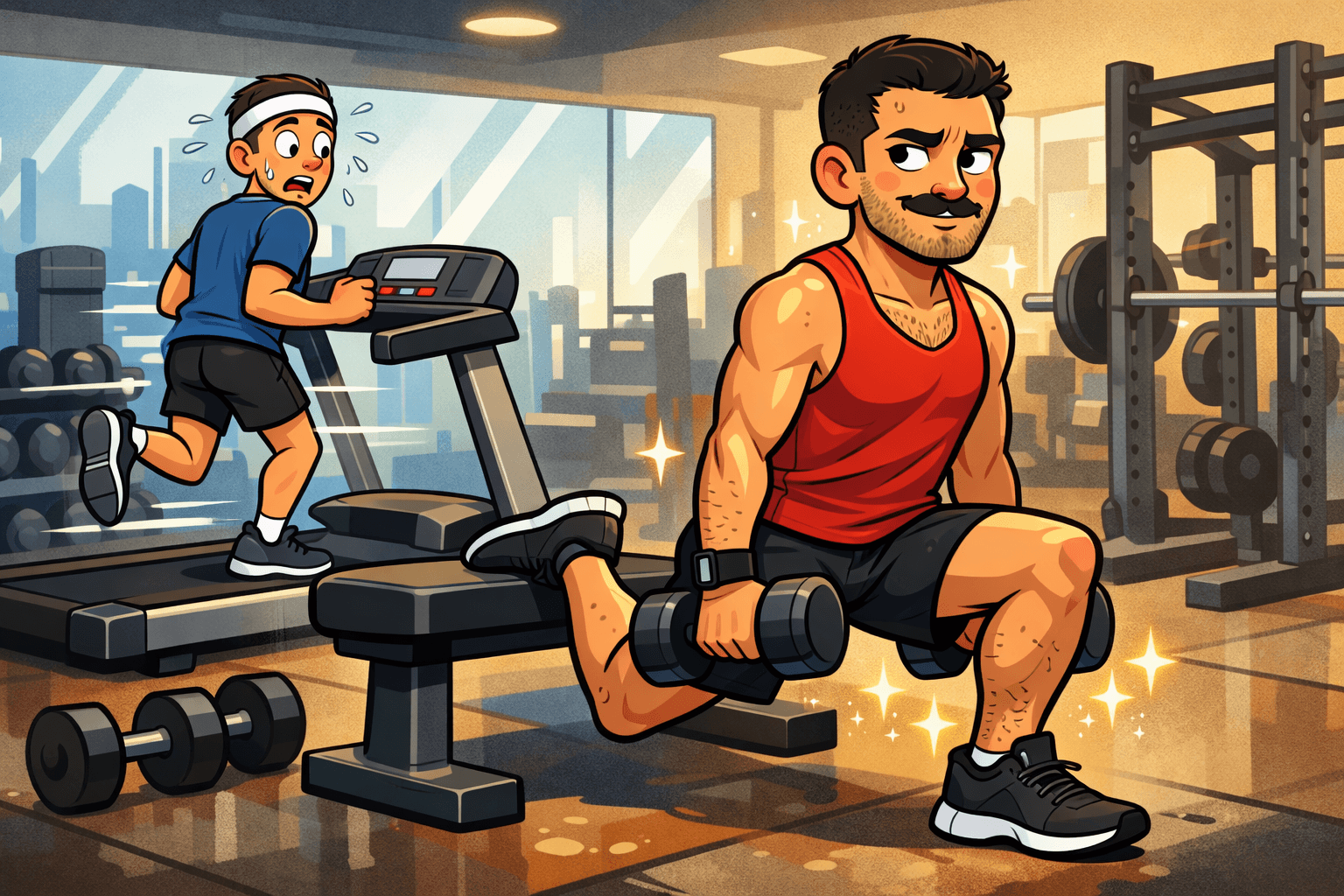
Bulgarian split squats and running are not competing for the same job. Comparing them directly is a bit like asking whether a hammer or a screwdriver is better. Better for what? The answer changes entirely depending on what you are trying to achieve.
Running vs. BSS: If you want a peachy bum
✅Bulgarian Split Squats.
Bulgarian split squats. It is not a close competition, and if you came here specifically for this question, you can stop reading now and go and hate yourself on a bench.
Throughout the movement, the front hip is driven into deep flexion, which stretches the glute max while simultaneously demanding it contract hard to drive you back to standing. A muscle loaded while stretched produces significantly more mechanical tension than the same muscle contracting from a shortened position, and research consistently shows that this is one of the primary triggers for muscle growth.
Add weight over time, do them consistently, and the glutes will respond by growing firmer and peachier.
❌Running.
Some people swear running gave them a better bum, and they are probably not lying, but chances are they either had massive gains when they started from zero and then plateaued, or they have a particular body type that recruits the glutes more than the average person.
The broader principle is that any movement engaging the glutes can develop them to a degree — running, Bulgarian Split Squats, even getting up from a chair repeatedly qualifies.
Running vs. BSS: If you want stronger legs overall
✅Bulgarian Split Squats.
The quads, hamstrings, and hip stabilisers are all loaded meaningfully in a single-leg squat. The stabilisation demand alone, the constant micro-corrections at hip, knee, and ankle to stop you toppling sideways, recruits muscle groups that bilateral exercises tend to underwork.
❌Running.
Running produces muscular endurance, but not the kind of strength or size that comes from heavy, low-repetition loading. If stronger legs in a functional, structural sense is the goal, Bulgarian Split Squats is the tool.
Running vs. BSS: If you want better cardiovascular fitness
✅Running.
Bulgarian Split Squats may elevate your heart rate, especially early on when the effort feels enormous and your body is not remotely adapted to the demand, but it is not a cardiovascular training tool. It does not sustain the kind of continuous aerobic effort required to drive meaningful improvements in VO₂ max — the maximum rate at which your body can consume and use oxygen, which is the primary determinant of endurance fitness — or cardiac efficiency.
Runnings vs. BSS: If you want to lose weight or change your body composition
This one is more nuanced than either camp usually admits.
✅Running.
Running burns more calories per session than Bulgarian Split Squats, particularly at higher volumes. On that basis, running appears to win for fat loss.
✅Bulgarian Split Squats.
Bulgarian Split Squats builds muscle, running does not, and muscle tissue increases your resting metabolic rate. More muscle means more calories burned across the entire day, not just during exercise. This is a modest effect in practice, but it compounds over time and has implications for body composition beyond what the training session itself burns.
The honest answer for body composition is that a combination of both tends to outperform either in isolation: cardiovascular training for caloric expenditure and metabolic health, strength training for muscle development and the structural adaptations that support it.
If you’re a runner specifically
Running is excellent at making you better at running. It is considerably less good at addressing the weaknesses that running tends to produce.
The most relevant is glute underactivation. Running is a cyclical, bilateral movement, which means both legs move through the same pattern simultaneously and the stronger side can compensate for the weaker one indefinitely. Many runners become progressively quad-dominant over time — the quads taking on more of the propulsion work while the glutes contribute less than they should — and running gives this pattern no particular reason to change.
Bulgarian Split Squats corrects glute underactivation by removing the option to compensate. Done consistently, glutes that previously switched off mid-run begin contributing to hip extension actively, without having to be consciously cued.
Bulgarian Split Squats for injury prevention
Weakness in the hip stabilisers, particularly the glute medius, is associated with knee pain, hip drop, and IT band issues in runners. Bulgarian Split Squats loads the stabilising role of the hip directly in a single-leg stance, which is the position running actually happens in.
Running without any strength work is a reasonable way to get fit and an effective way to eventually get injured. Bulgarian Split Squats are not the only fix, but they address the right things.
Running vs. Bulgarian Split Squats: Comparison
Running and Bulgarian Split Squats are not doing the same job. Pick the one that matches what you actually want, accept that you probably need both, and prepare to resent at least one of them.