Enriched rye and wholemeal bread recipe
A proper enriched rye and wholemeal loaf with eggs, butter, and milk. Dense, soft-crusted, high in fibre, and delicious.

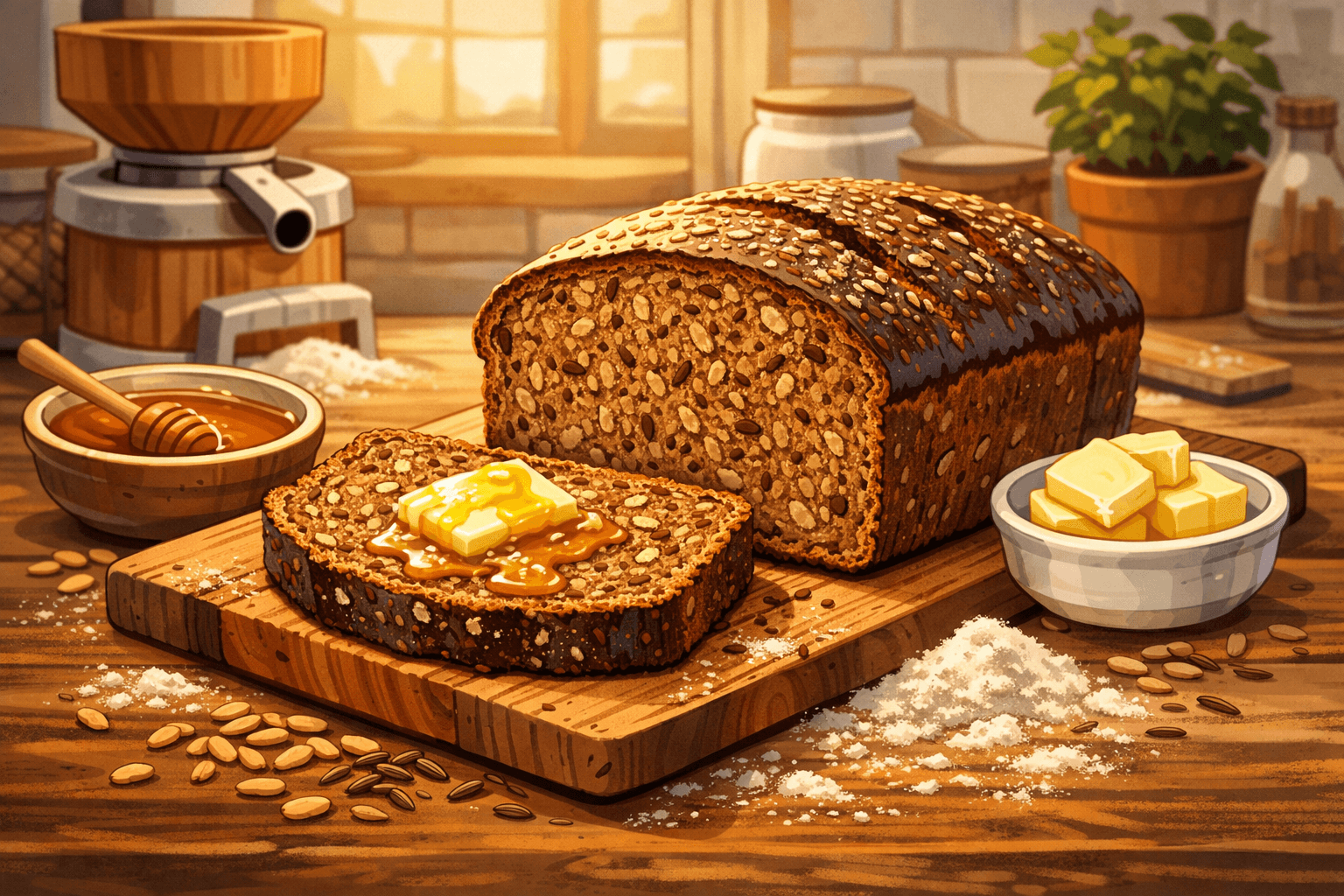
There is a specific pipeline that a certain kind of runner follows. It starts with mileage. Then nutrition. Then “what’s actually in the bread I’m eating.” Then a grain mill arrives in the post and you’re explaining to your partner why the kitchen smells like a health food shop.
That is roughly how this loaf came to exist.
If you came here looking for rustic sourdough, I’m sorry. I haven’t bought into the “rustic” craze with a crust so hard and dry you can’t even bite into it. I firmly believe bread should be soft and the less crust the better.
Makes: 1 medium loaf | Time: ~3 hours active + 8–12 hours rest overnight
Nutrition
Ingredients
Method
- Activate the yeast. Warm the milk to about 38°C — warm enough to feel comfortable on your wrist but not hot enough to kill the yeast (which it will do above 43°C). Stir in the honey and sprinkle over the yeast. Leave for 10 minutes until foamy.
- Mix the dough. Combine both flours, salt, and caraway seeds in a large bowl. Add the yeast mixture, eggs, and softened butter. Mix thoroughly with a spatula. Rye flour contains less gluten, so kneading it isn’t going to do much. You’re aiming for a thick, heavy paste rather than a shapeable dough.
- First rise. Cover with cling film or a damp towel. Leave somewhere warm for 1–1.5 hours. Expect a modest puff and some bubbles rather than the dramatic dome you’d get from a white loaf. The lower gluten content means less gas retention and a smaller rise.
- Shape and second rise. Spoon into your greased loaf tin, filling about two-thirds full. Smooth the top with a wet spatula or wet fingers — rye paste is no fun to handle dry. Cover loosely and leave until the dough just crests above the rim, roughly 45–60 minutes.
- Bake. Preheat to 180°C (160°C fan / 355°F). Tent the tin loosely with foil and bake for 35 minutes. Remove the foil and bake for a further 10 minutes until deep brown. The internal temperature should reach around 95°C — if you don’t have a probe thermometer, a skewer inserted in the centre should come out clean.
- Wrap. The moment the loaf comes out of the oven, wrap it loosely but completely in a clean tea towel while still hot. This traps the steam escaping from the loaf and keeps the crust from hardening. Leave it wrapped as it cools.
- Rest — Leave overnight on the counter, wrapped in the tea towel — around 8–12 hours before slicing. The crumb continues to set as it cools. Slicing too early produces a gummy, slightly underbaked texture that will make you think you did something wrong. You probably didn’t.
The number worth paying attention to is the fibre: roughly 4.4g per slice, which is genuinely high. Rye and wholemeal are among the most fibre-dense flours you can bake with, and at that level per slice, two slices alongside a meal contributes meaningfully to the 30g daily target most people dramatically underachieve.
One relevant caveat for runners: because of this fibre density, this is not the bread you want to eat immediately before a long run or race. The same property that makes it excellent for everyday nutrition — slow digestion, sustained energy — makes it less than ideal when you want your gut to be quiet and cooperative for three hours. Treat it like other high-fibre carbs: useful well ahead of training, not the morning of.
FAQ
Can I mill my own wholemeal flour instead of buying it?
Yes, strongly encouraged! The flavour is genuinely better — fresher, nuttier, more complex.
My dough looks more like a thick batter than a dough. Is that wrong?
No. This is correct. Rye flour absorbs liquid differently to wheat and doesn’t form the same gluten network. The dough should be thick and scoopable, not kneadable. If you can shape it into a ball, you’ve probably used too little liquid.
Can I skip the overnight rest and slice it after a few hours?
You can, but the crumb will be gummy and the texture won’t be right. The rest period isn’t optional patience-testing — it’s the final stage of the bake. The starch continues to set as the loaf cools, and cutting it too early interrupts that process. Eight hours is the minimum; twelve is better.
Can I freeze it?
Yes. Slice before freezing and toast directly from frozen. The texture is slightly denser after freezing but entirely acceptable.
Is this suitable for carb loading?
Not directly before a race or long run, for the same reason you wouldn’t eat a bowl of oats an hour out — the fibre load is too high to process comfortably under physical stress. For pre-race fueling, the principles are a bit different. This bread works best as an everyday staple rather than a race-week special.
Does this work as a post-run recovery food?
It’s a solid option. The carbohydrate supports glycogen replenishment, and the protein from the eggs and wholemeal flour contributes to repair — not at the level of a dedicated recovery shake, but as part of a real meal, it’s a reasonable choice.
What does caraway actually add?
A slightly aniseed, faintly herbal flavour that is traditional in Northern European rye bread. It’s subtle rather than dominant. I’m personally not a huge fan and often replace it with sunflower and pumpkin seeds.