Exercise-associated muscle cramps (EAMC): what causes them and what actually helps
What exercise-associated muscle cramps actually are, what causes them, and what the evidence says about fixing and preventing them.

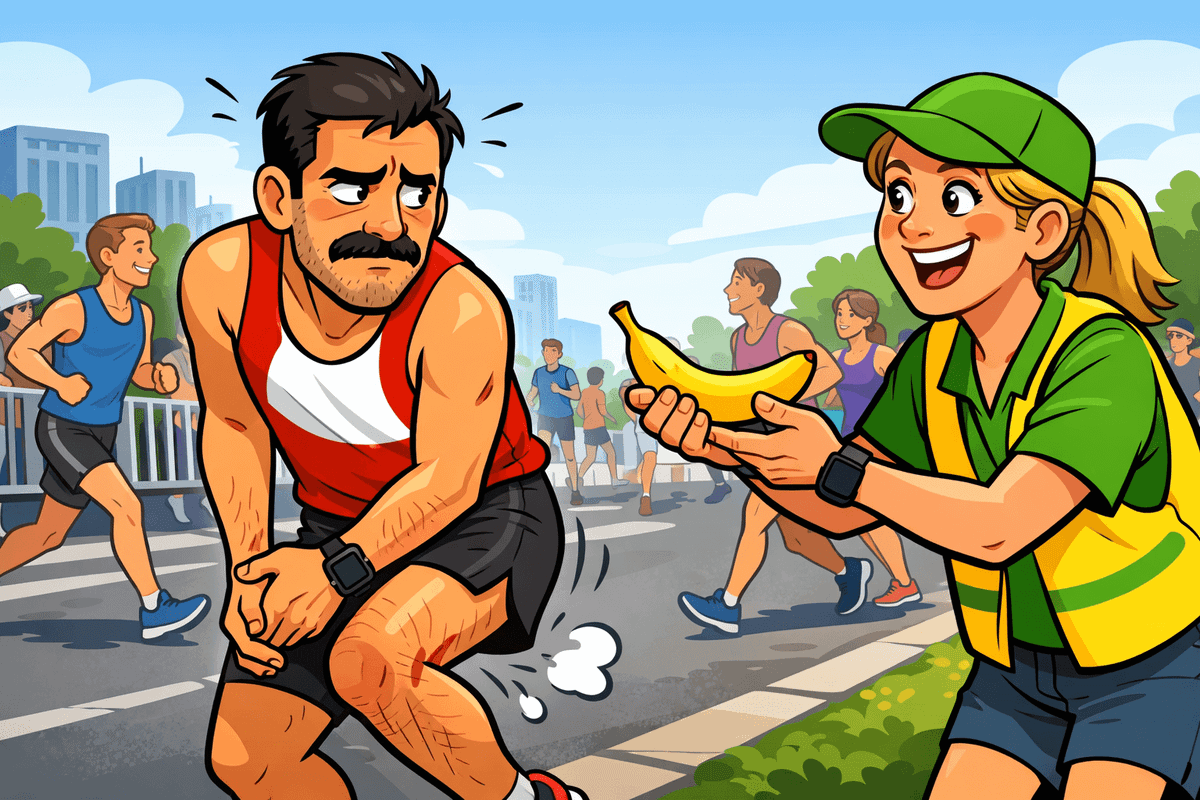
If you cramp during a race, someone nearby will immediately tell you to drink more water. If that does not work, they will suggest a banana. If the banana does not work, they will repeat the water advice, but louder.
The two leading theories for exercise-associated muscle cramps (EAMC)
There are two main explanations for why EAMC happens, most runners who cramp regularly are probably dealing with elements of both, but they are not equally well-supported by the evidence.
Electrolyte loss and dehydration
The older and more widely repeated explanation is that sodium loss through sweat, particularly in heat or in heavy sweaters, lowers the electrical threshold at which muscle fibres fire spontaneously. Lose enough sodium and fibres begin contracting without instruction.
The evidence for this as the primary driver of EAMC is weaker than its cultural status suggests. Controlled prospective studies have not found consistent electrolyte differences between runners who cramp and those who do not. What the evidence does support is electrolytes as a genuine threshold-modifier: not the root cause in most runners, but a variable that brings the ceiling closer to the surface. Heat does not cause cramps directly either — what it does is raise sweat rate, accelerate sodium loss, and increase perceived exertion at any given pace, stacking several unfavourable variables at once.
The practical experience of many runners who experiment with salt tablets reflects this exactly: cramps push back in the race but do not necessarily disappear completely. That is what raising a threshold looks like rather than fixing a root cause.
Neuromuscular fatigue
The better-evidenced explanation is that EAMC is caused by a breakdown in the neural feedback loop that governs muscle contraction — specifically, the system that prevents your muscles from contracting when you have not asked them to. Under sustained effort at high intensity, this system accumulates fatigue to the point where muscles begin contracting on their own and cannot easily be told to stop.
A study of 210 Ironman triathletes, found the only meaningful predictors of cramping were racing faster than training had prepared the athlete for, and a personal history of cramping. Electrolyte levels and dehydration markers showed no significant difference between crampers and non-crampers.
Are my cramps caused by electrolyte loss or neuromuscular fatigue?
Neither cause announces itself cleanly, but your history gives you information.
Cramps that ease when you take on sodium mid-race, that are noticeably worse in heat or humidity than in cool conditions, or that correlate with days you have sweated heavily and drunk little — these point to electrolytes doing real work in your picture. Start there. It is the simpler lever and it is easier to test.
Cramps that arrive regardless of conditions, at a similar point in similar-effort races, that move sequentially through the muscles working hardest, and that salt tablets have touched but not solved — these point toward neuromuscular fatigue as the primary driver.
First steps to prevent exercise-associated muscle cramps (EAMC)
Sort electrolytes and hydration first, but responsibly. The principle is drinking to thirst rather than to a rigid schedule — a study of 2002 Boston Marathon finishers found 13% had hyponatremia, caused not by dehydration but by drinking more than they sweated out. There is no documented case of a recreational marathon runner dying of dehydration during a race, but there are multiple documented deaths from hyponatremia. More is not always the answer.
For sodium: in heat, in long efforts above 90 minutes, or if you are a heavy sweater, electrolyte drinks or salt tablets alongside water are appropriate. In normal conditions, drinking to thirst is sufficient for most runners.
If adjusting electrolytes makes a material difference, keep going with it. If it helps partially but cramps persist despite genuinely managed hydration and sodium, the neuromuscular mechanism is the more likely primary cause. Fixing that requires a different approach: more race-pace specific training, more strength work, and more conservative pacing early in races.