Hoka Semi de Paris 2026 Review
Paris half marathon: not a single famous landmark in sight, and somehow still worth every kilometer.

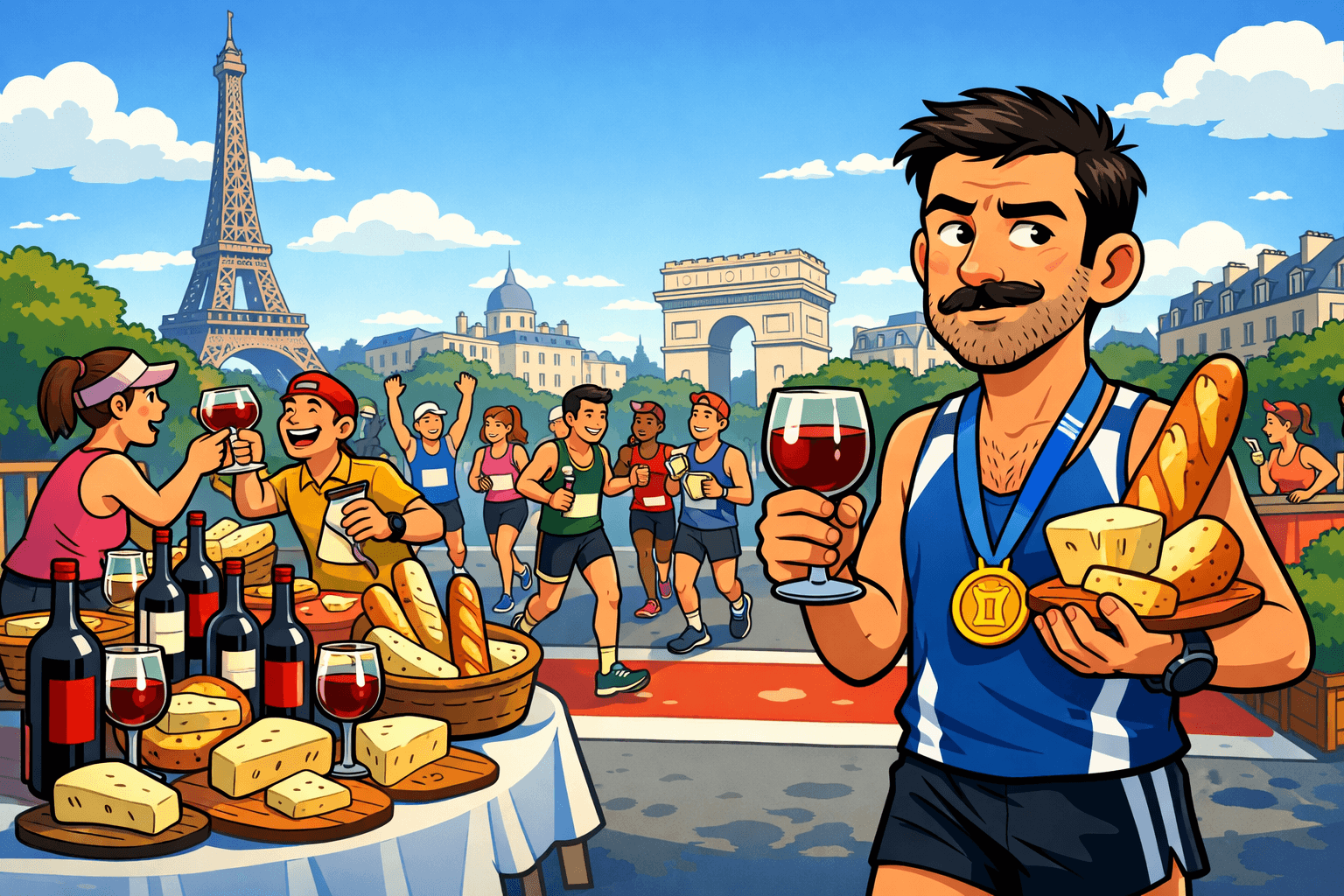
Paris has the Eiffel Tower, the Arc de Triomphe, the Louvre, and roughly 400 years of architecture worth staring at while moving slowly. The Hoka Semi de Paris takes you past almost none of it.
What it lacks in postcard moments it makes up for in organisation, a flat course, and a finish line that puts you within walking distance of the best post-race wine and cheese in the world. As trade-offs go, there are worse ones.
Expo and bib collection
Bib collection was right outside the metro exit, well-signposted, with almost no queue to pick up your race number and T-shirt when I went (Saturday afternoon before the race).
The expo itself was… Underwhelming. Hoka, as the title sponsor, had the biggest stand — logical, fine. Beyond that, it was a lot of brands that had no obvious business being at a running expo. Laundry detergent. Toothpaste. Brands you'd walk past in a supermarket and still not stop for. What was conspicuously absent: sports nutrition brands, tape, lube, sunglasses, or anything you might actually want before running 21 kilometers. A brand like Janji, for example, would have slotted in perfectly. Instead, it felt like a few running brands got surrounded by people who found a spare table.
The start line
Boulevard Saint-Germain is not the most obvious place to start a half marathon, but it works. Getting there on the metro was easier than expected — no carnage, no sardine situation on the metro, and no frantic sprint to make a wave. There were urinals everywhere along the start area, which is the kind of logistical thoughtfulness that deserves more credit than it gets.
Less credit-worthy: the ratio of urinals to portable toilets for the ladies was roughly 12 to 2. Whoever made that decision has presumably never had to queue for a toilet while their wave time approaches.
The Paris Half Marathon course
The bulk of the race loops around Bois de Vincennes — a large public park in the east of the city. If you've booked this race hoping to run past the Eiffel Tower, you will be disappointed, and also possibly lost. What you get instead is a wide, mostly flat course through parkland and quieter roads, which turns out to be quite a pleasant way to race.
There are some hills in the latter part of the race in the form of tunnels. Going under and coming back up creates short, sharp inclines that are fine on their own but become annoying when the road narrows at the top and you're trying to pass someone who set off slightly too ambitiously and is now shuffling at 7 min/km pace. There is no good solution here. You either accept it or you start threading through gaps like you're late for something.
In the later kilometers, the course traces the Seine, which is where the race changes character. The crowd support gets louder, there's actual atmosphere, and at some point you pass through an underpass that a DJ has claimed as their personal venue. It's extremely dark, extremely loud, and the only visible thing ahead is a corridor of reflective running gear bobbing into the strobe lights. It is completely unnecessary and also my absolute highlight of the race.
Water stations and sustainability
The Hoka Semi de Paris runs on a no-plastic-bottle, no-cup policy. There are water refill stations approximately every 5km and you are expected to bring your own vessel.
The policy is admirable. Fifty thousand runners handing back empty bottles or cups at speed generates an extraordinary amount of waste, and the race is clearly making a genuine effort to address that. The medal is made entirely from recycled materials — minimalist in design, which you'll either respect as a statement or compare unfavourably to the ones that come in a presentation box.
The one legitimate grievance: there were signs throughout the course reminding runners not to litter. There were zero bins. Sticky and disgusting gel packaging has to go somewhere and the options are your pocket, or the road.
The finish line
If you've run a large city marathon before, you're used to the finish line being the beginning of a second, considerably less enjoyable journey through a long, narrow chute with a foil blanket and a bag of crisps at the end. For example NYC Marathon finishes in Central Park and then deposits you into a walk so long it starts to feel like a cooldown race.
Paris was the opposite. Medal, water top-up, some fruit, a piece of cake (because France) and then out. Clean, efficient. The kind of finish experience that makes you feel like the organisers actually thought about what a person who's just run 21km might want, which is mainly to go home or the pub.
Paris Half Marathon: is it worth it?
This is not a sightseeing race. If you want Paris as a backdrop, this is not the one. If you want a well-organised, flat, legitimately fast course with good crowd support in the final stretch and the reasonable promise of excellent food and wine within ten minutes of finishing — it's a strong choice.
It suits PB hunters who want a flat course. It suits first-timers who want solid organisation and predictable logistics. It suits destination runners who can get more out of a Paris weekend than just the kilometers. And it suits anyone who finds the idea of racing in a city that takes its post-race eating seriously to be a perfectly valid reason to enter.