
Is a 20 week marathon training plan too long?
Twenty weeks sounds safe, but is it just too long? Here’s what really happens in a 20-week marathon plan — physically and mentally.

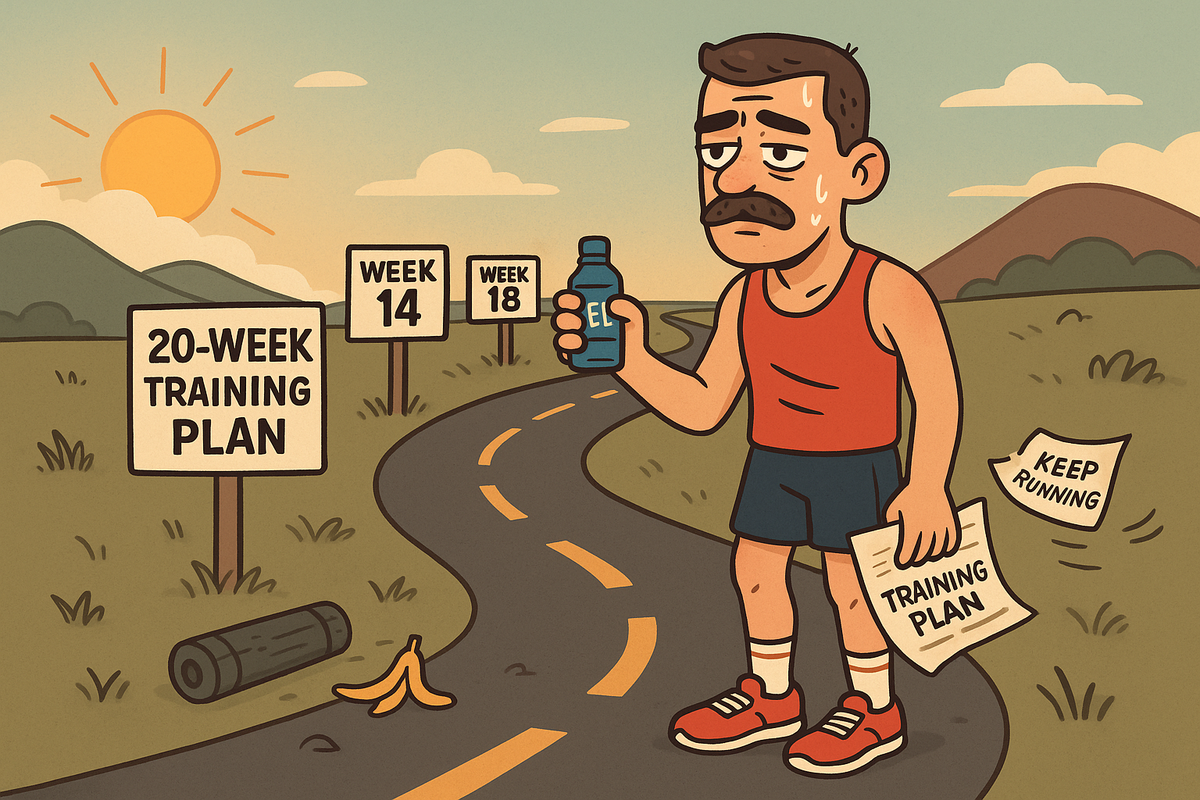
Twenty weeks is nearly five months. That’s half a year of “I can’t, I’ve got a long run”. Half a year of eating to fuel training, sleeping like it’s your job, and wondering when your friends stopped inviting you to things.
The problem with the 20-week plan
The 20-week plan is sold as “gradual” and “sensible” — the responsible way to prepare. It promises safety, structure, and time to build a base. In theory, it’s the adult choice. In practice, it’s like revising for an exam that never seems to arrive. By week 12, you’re not fitter. You’re just slightly better at managing fatigue and pretending you enjoy recovery shakes.
Why 20 week marathon plans exists
Long plans exist for one good reason: injury prevention. If you’re starting from scratch or averaging fewer than three runs a week, you need a long ramp-up to avoid snapping something halfway through. The extra time allows your connective tissue (tendons, ligaments) to adapt to impact.
It also helps people who aren’t used to high weekly mileage. Aerobic development, the ability of your heart, lungs, and muscles to efficiently use oxygen, happens slowly. Extending the plan to 20 weeks means you can increase distance in tiny increments without overwhelming your body.
The physiology of boredom
Here’s the thing: aerobic fitness doesn’t increase in a straight line forever. You get the biggest adaptations in the first 8–12 weeks — your body builds more mitochondria (the energy-producing “power plants” inside cells), your muscles learn to store more glycogen, and your capillaries expand to deliver more oxygen.
After that, gains plateau. You maintain what you’ve built, but improvements slow down. Which means by week 14 of a 20-week plan, you’re not building much. You’re mostly practicing fatigue tolerance and fighting off mental burnout.
If you handle it well, that’s useful. But if you’re dragging yourself through each session just to tick boxes, and the plan might be doing more harm than good. Training stress only works if you recover and adapt. If you’re permanently knackered, you’re just running tired, not running stronger.
What a long plan does to your head
Marathon training has a way of bending time. The first few weeks fly by — you’re motivated, organised, buying gels like a professional athlete. Then you hit the middle section, where every long run blurs into the next.
By week 16, the novelty’s gone. You’re fit, but you’re bored. You start to forget what it feels like not to be “training.” And when taper finally arrives, you don’t feel rested — you feel lost.
That’s the hidden cost of a 20-week plan. It’s long enough to build fitness, but also long enough to erode enthusiasm.
What does a 20 week training plan feel like?
I gave myself a 20 week training plan for the New York City Marathon 2025. For a couple of reasons: I started my training plagued by plantar fasciitis and my weekly mileage has only been around 20k for the last few years. I’m also at an age where my body disagrees with most things I do, so I knew I had to be careful with increasing mileage.
I hit every single run, lifted weights (though not as much as I should have), did the yoga, stretched the glutes — all the responsible stuff. And technically, it worked. I did not get any additional injuries and my plantar fasciitis disappeared completely during my taper.
But somewhere around week 15, I’d mentally checked out. The long runs felt obligatory, not purposeful. I wasn’t pushing endurance anymore, just repeating it. Physically I was fine. Psychologically, I was flat. So was it too long? Probably. I would have been better off with 16 weeks of focus instead of 20 weeks of duty.
When a 20 week marathon training plan makes sense
If you’re new to running, twenty weeks gives you the buffer you’ll need to stop breaking yourself. It’s not glamorous, but connective tissue adapts slower than motivation, and that extra time lets your legs harden up before you start pretending you’re Kipchoge.
If you’ve fallen off the running wagon, say you’ve not trained properly for six months and your Garmin has started sending you “remember me?” notifications. Twenty weeks is long enough to rebuild a base without panic-training.
If you’re injury-prone, the long runway is your safety net. You can increase mileage at a snail’s pace and still make the start line intact. The same goes if you like the idea of spreading the load — lower weekly mileage over a longer stretch can make the whole thing feel more manageable, even if it drags on emotionally.
When a 20 week marathon training plan doesn’t make sense
If you already have a solid aerobic base, say you run half marathons for fun and your Sunday long run is “just a bit of time on feet” — you don’t need twenty weeks. You need focus. Stretching the plan that long won’t make you fitter; it’ll just flatten your enthusiasm.
If you’re time-poor or mentally cooked. The longer the plan, the more likely you are to hit burnout somewhere around week twelve, when even the thought of gels makes you queasy.
Would I recommend a 20 week marathon training plan?
Twenty weeks isn’t too long for your legs, but it is too long for your attention span. If you’re new to marathons, the 20 week marathon training plan gives you safety and structure. If you’re already running regularly, it’s like being stuck in a training loop that lasts slightly longer than your enthusiasm.
Fifteen to sixteen weeks is probably the sweet spot: long enough to build endurance, short enough to stay excited. Anything more, and you’re just collecting blisters for sport.