Why am I in so much pain after leg day?
Chest day leaves you a bit stiff while leg day leaves you gripping the toilet seat. The physiology behind why leg day DOMS is in a different category entirely.

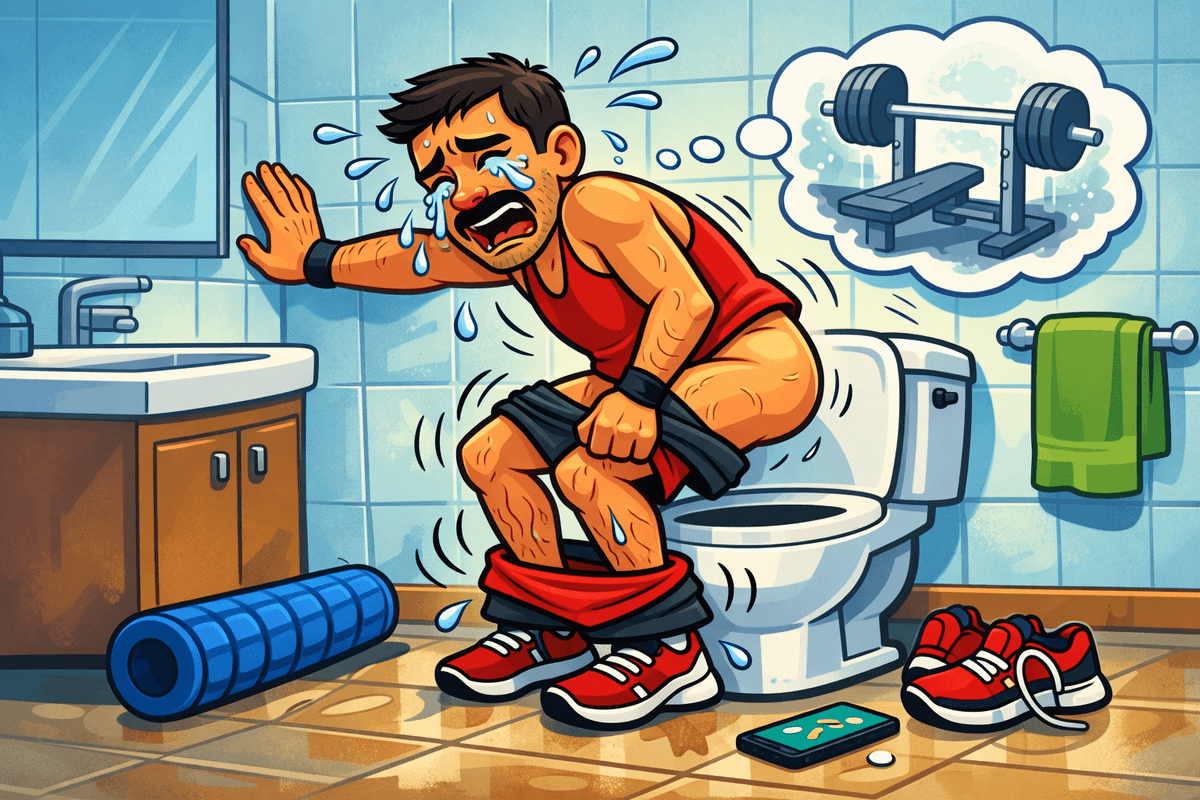
Every person who has ever done a serious leg session has had the same experience. Two days later you can’t get out of bed without moaning loudly, and sitting on the toilet is so difficult you seriously consider standing up for a number two.
It is entirely predictable, and it comes down to a handful of physiological reasons that stack on top of each other in a way that makes leg day DOMS uniquely brutal.
Why leg day DOMS hits harder
The quads, hamstrings, glutes, and calves together represent the largest concentration of muscle mass in the human body. A heavy squat session, leg press, and Romanian deadlifts in the same workout recruit an enormous volume of muscle fibre — vastly more total tissue than a chest and shoulder session, even if both felt equally hard at the time.
DOMS, or delayed onset muscle soreness, is primarily driven by micro-tears in muscle fibres and the subsequent inflammatory response your body uses to repair and rebuild them. More total muscle tissue damaged means a larger, more sustained inflammatory response — and therefore more soreness, more stiffness, and a longer recovery window.
A hard upper body session might damage a few hundred grams of muscle tissue. A leg session is working on kilograms all at once.
Why leg day hurts so much
Eccentric and concentric describe the two phases of any resistance movement. The concentric phase is when the muscle shortens — standing back up from a squat, curling a dumbbell toward your shoulder. The eccentric phase is the opposite: the muscle lengthens under tension while controlling the movement — the descent into a squat, lowering the dumbbell back down. Same exercise, two very different demands on the tissue.
Eccentric loading is the primary driver of muscle damage and DOMS. Research consistently shows it causes significantly more micro-trauma than the concentric phase, and this is where leg day becomes particularly punishing. Think about what a squat actually involves: a slow, loaded descent under the full weight of the bar, with your quads under enormous tension through a long range of motion. Romanian deadlifts do the same to your hamstrings. Leg press, lunges, step-ups — all of them involve substantial eccentric phases with heavy loads through large ranges of movement.
Compare this to a bench press or a lat pulldown. The eccentric phases are there, but the loads are lower and the ranges of motion shorter relative to the size of the muscles involved. Upper body exercises simply cannot generate the same eccentric stress as loaded lower body movements.
This is also why walking downstairs is so uniquely punishing after leg day. It is essentially a continuous series of eccentric quad contractions under body weight, applied repeatedly to already-damaged tissue. Every step is a small insult to something that is already crumbling.
Why your legs hurt more after leg day than the rest of your body
This sounds counterintuitive, but your legs carry your full bodyweight every waking hour. They walk, stand, climb stairs, and generally keep you upright all day, every day. As a result, they have a high baseline level of conditioning compared to most upper body muscle groups.
The baseline conditioning makes it possible to load them very heavily in the gym — and the gap between daily activity load and gym load is enormous. When you squat 100kg, your quads are experiencing a stimulus dramatically beyond what they handle in normal life. That dramatic spike in load is precisely what drives significant DOMS. The stronger and more capable a muscle group, the more absolute damage a serious session can inflict.
Your chest, by contrast, is not carrying anything around all day. It has a lower baseline capacity, which means you hit its ceiling at lower absolute loads — and therefore accumulate less total damage per session.
Why DOMS after leg day lingers longer than upper body soreness
Upper body DOMS is annoying. Leg DOMS interferes with your existence.
After a heavy leg session, the sheer volume of inflamed tissue in your lower body creates pressure and subtly restricts local circulation, amplifying the sensation of soreness. More importantly, your legs never actually get to rest. Every step you take, every flight of stairs, every time you stand up from a chair — all of it applies low-level load to muscles that are already in active repair.
A sore chest can genuinely rest between sessions. Your legs cannot. They are constantly being reminded that yesterday was leg day, which keeps the inflammatory response active in a way that upper body muscle soreness simply does not replicate.
Why leg day is so painful beyond just the muscles
Heavy compound leg work, particularly squats and deadlifts, places an exceptionally high demand on the central nervous system (CNS), the network that coordinates force production across all your muscles simultaneously. When the loads are heavy and the muscles numerous, the neurological cost is significant.
This is why you can feel exhausted — genuinely, systemically tired — after a heavy leg session in a way that a hard chest workout rarely produces. CNS fatigue compounds the local muscle damage, extends the overall recovery timeline, and contributes to the general sense of having made poor life decisions.
It also explains why experienced lifters often treat heavy leg days as events that shape the entire training week around them, rather than sessions that slot in between everything else.
Why does leg day hurt so much more than chest or back day?
Upper body muscles are simply smaller. The pectorals, deltoids, biceps, and triceps represent a fraction of the total muscle mass in your legs. Even a very thorough upper body session is working on less total tissue, with lower absolute loads, through shorter ranges of motion, and with significantly less eccentric demand.
Add to this the fact that your upper body gets genuine rest between sessions, and the conditions for catastrophic DOMS simply are not there. Sore shoulders do not stop you from sitting down without crying.
Does leg day DOMS get better with consistent training?
Yes, to a point. The repeated bout effect — a well-documented phenomenon in exercise science — means the same workout causes significantly less DOMS the second and third time you do it. Your muscles begin adapting to that specific type of stress, reducing the micro-damage produced by the same session. Consistent training reduces both the severity and duration of DOMS considerably.
However, the structural reasons why legs hurt more than upper body do not go away. The muscle mass is still larger, the eccentric loading is still greater, and your legs will always be doing something the rest of the day. What changes is the magnitude, not the fundamental biology.
If you do leg day once every few weeks, you will get wrecked every time. If you do it consistently, you will get wrecked considerably less. That’s the deal.