
Why runners get wrecked by leg day and what to do differently
Runners already punish their legs for hours every week. Add a standard gym leg day and something breaks; here’s why runners get hit harder and how to stop it wrecking your training.

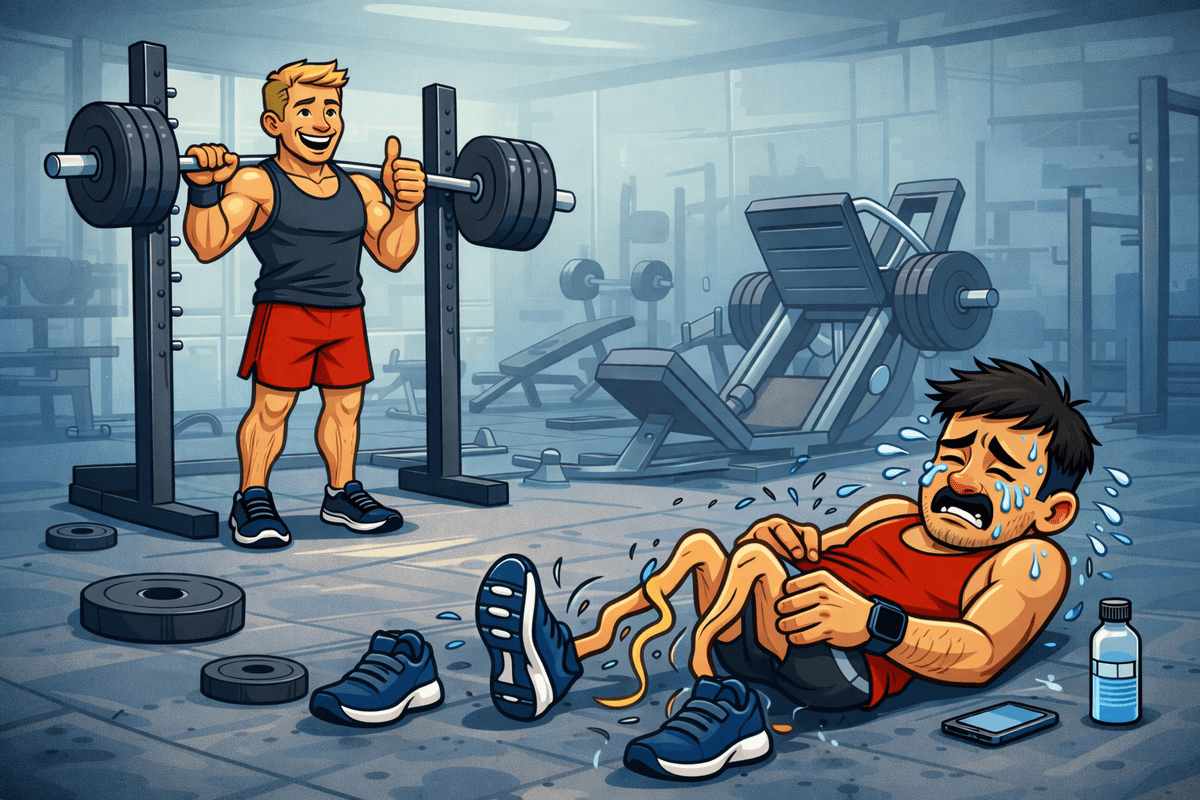
Well done - you decided to add strength work! Here you are, doing leg day properly: squats, leg press, maybe some Romanian deadlifts. You feel great about yourself. Then two days later you cannot run, and you are starting to question your life choices as you’re crying on the bathroom floor because you missed the toilet trying to sit down.
The problem is not that leg day doesn’t work for runners. It is that a standard gym leg day was not designed for someone whose legs are already logging serious weekly mileage — and the collision between those two demands is predictably ugly.
Why leg day DOMS hits runners harder than everyone else
Endurance running develops slow-twitch (Type I) muscle fibres. These fibres are fatigue-resistant, fuel-efficient, and built for sustained output over long distances. The more running you do, the more your legs adapt toward slow-twitch dominance — it is why elite marathon runners have very different leg physiology to sprinters, who are built around fast-twitch (Type II) fibres that produce explosive, high-force efforts.
Heavy gym lifting is fundamentally a fast-twitch stimulus. When you squat heavy, you are asking slow-twitch dominant legs to absorb a type of loading they have been progressively de-specialised for. The muscle fibres recruited under that kind of load are less adapted to it, produce more damage per session, and recover more slowly from the stimulus.
Why adding leg day to a running routine is harder than it sounds
A gym-goer who does leg day on Tuesday can return on Friday with legs that have done relatively little in between. A runner who does leg day on Tuesday has probably run on Wednesday and Thursday, compounding the problem in both directions. You are attempting a leg session on legs already carrying running fatigue, which means the tissue is working at a deficit before you have loaded a bar. Then your running sessions are operating through residual DOMS from the gym. Neither gets the conditions it needs to work properly.
The cumulative fatigue stacks over weeks, forcing you to abandon the gym routine to protect your running, or it degrades your running quality to the point where it stops being useful. Most runners find the gym routine goes first, because that’s the easier thing to drop when something has to give.
Why standard leg day breaks down completely for runners
The goal of strength training is adaptation: stress the tissue, allow it to rebuild stronger, repeat. If a standard leg session leaves a runner unable to train properly for five or six days, the recovery window is longer than the training week. You are accumulating damage faster than you can absorb it, which stops being training and it is just wearing yourself down.
This is why the intensity and approach matter as much as the exercise selection. Getting the stimulus right is the entire problem.
Should runners drop the big compound lifts?
Squats and leg press are genuinely excellent exercises. They build total lower body strength efficiently, produce a significant hormonal training response, and transfer well to athletic performance. The reputation of compound lifts is largely deserved.
The challenge for runners is that heavy compound movements generate the most eccentric damage per session — that long, loaded descent in a squat is precisely what produces the DOMS that breaks your running week. They are also less specific to running mechanics than, say, single-leg movements.
Single-leg movements are a more practical starting point. Bulgarian split squats, single-leg Romanian deadlifts (RDLs), step-ups, and Copenhagen planks are more specific to running mechanics, produce more manageable DOMS at equivalent effort, and build the hip stability and single-leg strength that actually reduces injury risk on the road.
Compound lifts shouldn’t be abandoned completely, but treat them as a long-term project with a conservative starting point. If you want to squat at meaningful intensity alongside regular running, accept that the adaptation phase will temporarily disrupt your training.
How to add leg day to your routine without wrecking your running
The frame shift that actually works is this: you are not trying to build bigger or stronger legs in the gym sense. You are trying to make your running legs more durable and injury-resistant. That is a different goal, and it requires a different approach.
Lower load, higher reps.
Sets of 12–20 at moderate weight cause significantly less muscle damage than heavy sets of five or eight, still build the strength and stability you need, and match your slow-twitch fibre profile more naturally. You are training in the direction your legs are already adapted toward, which means the stimulus is useful without being catastrophic.
Frequency over intensity.
Two 25-minute sessions per week will produce better adaptation than one brutal session — and the damage from each stays within your recovery capacity. Consistent, manageable stimulus beats occasional carnage. This is especially true for slow-twitch dominant legs that respond better to repeated moderate work than infrequent heavy loading.
Time strength around your running week
There are two approaches that work, and which one suits you depends on how your week is structured:
- Pair strength with an easy run day: Your legs are not pre-fatigued, the strength session gets your full attention, and the two lower-intensity stimuli combine without either one compromising the other. This is the more forgiving option and probably the better starting point if you are new to combining both.
- Make hard days harder: do a hard run first, then strength work later in the day — ideally at least six hours apart. You stack the training stress into one window, which protects your other days for genuine recovery. Your body adapts to both stimuli together rather than carrying fatigue from one into the next day's session. Some coaches and more experienced runners swear by this, and there is decent research supporting it for reducing cumulative fatigue across the week.
Start absurdly conservatively.
The first two to three weeks should be bodyweight or very light resistance only. This is not timidity — it is the foundation that allows you to build frequency and consistency without derailing your running. The adaptation that prevents six-day DOMS needs to happen gradually, and the only way to get there is to start way below the threshold that causes it.
What to expect when you start strength training as a runner
Some DOMS during the adaptation phase is unavoidable. The goal is to keep it below the level that forces you to modify your running. If you finish a leg session and genuinely cannot predict whether you will run comfortably in two days, you have done too much. The session should feel disappointingly easy in the first weeks.
Around weeks four to six, your muscles have adapted enough to the specific stimulus that the same session produces significantly less damage. That is when you can begin adding load progressively. Not before.
Running and consistent strength work are entirely compatible. They just need to be introduced to each other carefully — like two cats in the same house who will eventually sleep in a pile, but will absolutely need separate rooms and a closed door between them for the first two weeks.