Are Bulgarian split squats worth it?
Brutal, exhausting, and uncomfortable: Bulgarian split squats are hated for a reason.

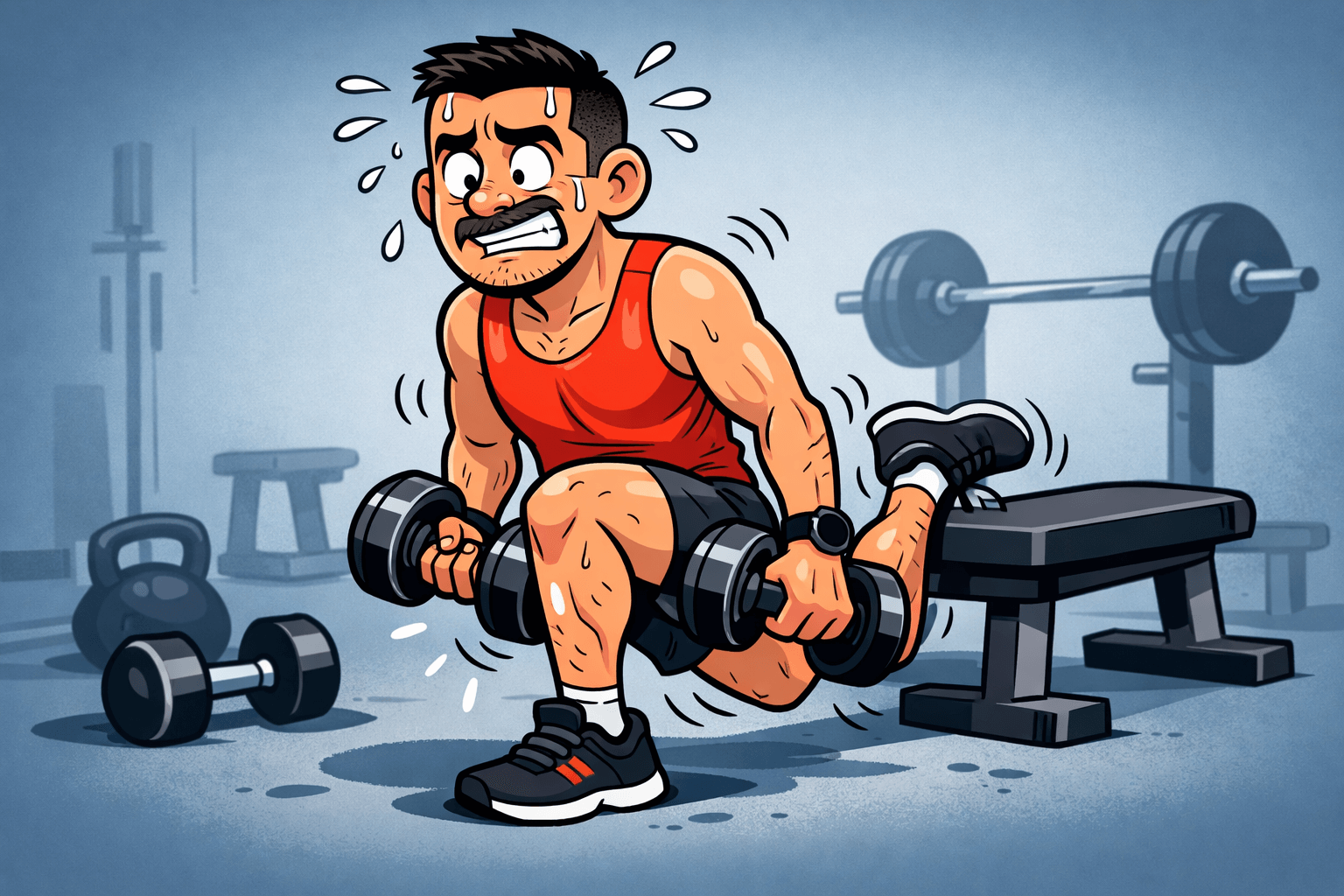
Bulgarian split squats are widely recommended, deeply hated, and performed reluctantly. The real question is not whether they are hard, the question is whether they are actually worth the suffering.
What a Bulgarian split squat actually is
A Bulgarian split squat is a single leg squat where your rear foot is elevated on a bench or box behind you. Your front leg does almost all the work. Your back leg exists mainly to reduce stability and make the exercise feel significantly worse than it looks.
This is what is known as a unilateral exercise, meaning it trains one side of the body at a time. That matters because most real-world movement happens one leg at a time.
Walking upstairs, changing direction, pushing off to sprint, stabilising under load, even just not collapsing when you misstep off a curb: all of these rely on single-leg strength and control.
Bulgarian split squats are popular because they load that pattern heavily, while also exposing strength differences and stability issues you can usually hide when both feet are on the floor.
Why Bulgarian split squats feel disproportionately brutal
If you have ever wondered why Bulgarian split squats feel harder than a heavy squat, there is a reason. Several, in fact.
One leg does all the work
In a normal squat, the load is shared between both legs. In a Bulgarian split squat, the front leg takes almost everything. That means higher force per leg, more muscle fibres recruited, and faster fatigue, even with very light weight. This is why six controlled reps can feel catastrophic.
Balance increases nervous system fatigue
This exercise is not just about muscle strength. It is also a balance and coordination challenge. Your nervous system is working constantly to stop you falling over, making small corrections at the hip, knee, and ankle. That neurological demand is tiring in its own right, which adds to the overall feeling of exhaustion. This is also why they feel harder than they look. Your muscles are not the only thing working.
The glutes are loaded in a stretched position
The front hip is deeply flexed, which places the glute max under load while lengthened. That combination is very effective for building strength and muscle. It is also excellent at producing delayed onset muscle soreness. This is why your glutes can feel destroyed for days afterwards, even if the session itself was short.
Why so many people are told to do Bulgarian split squats
Automatic strength where it actually matters
A lot of people struggle to use their glutes effectively, even if they are technically strong. Bulgarian split squats force the glutes to work in a single-leg position, without momentum or assistance from the other side. Over time, this makes glute contribution more automatic in everyday movement and sport, rather than something you have to consciously cue.
This applies whether you are running, lifting, cycling, or just trying not to overload your lower back every time you stand up.
Stability under load
In single-leg positions, the glute medius plays a key role in controlling hip and knee alignment. Weakness here shows up as wobbling knees, unstable hips, or compensation elsewhere. Bulgarian split squats load this stabilising role directly, which is why they are so commonly prescribed by physios and coaches across different sports. They are not about looking balanced. They are about staying aligned when the body is under stress.
Why runners talk about Bulgarian split squats so much
Automatic glute activation
As someone who struggles with glute activation while running, Bulgarian split squats help indirectly. By strengthening the glutes in a single leg stance, they make glute engagement more automatic.
When I do them regularly, my running feels more stable and less quad dominated, without me having to consciously think about it. This is often why strength issues in running only show up as vague pain or niggles once fatigue sets in, rather than being recognised earlier as simple strength limitations.
Pelvic stability during running
When you run, the glute medius on the stance leg helps control pelvic drop and prevents the knee collapsing inward. Weakness here is linked with common running issues like knee pain and hip discomfort. Bulgarian split squats load this stabilising role directly.
This is why physios love them, and why they appear so often in runner strength programmes. They target a real mechanical demand of running, not just aesthetics.
Why recovery feels so awful if you skip Bulgarian split squats
This is the uncomfortable truth I would rather not admit: because I avoid Bulgarian split squats whenever possible, every time they reappear in my programme it feels like a fresh insult. My body never fully adapts, so the soreness is always extreme.
Lowering the load and increasing the frequency would almost certainly improve this. Regular exposure reduces the shock, improves tolerance, and shortens recovery time. I know this. You probably know this. That does not mean I have accepted it. But the reason recovery feels horrendous is not that the exercise is uniquely damaging, it is that inconsistency keeps resetting the adaptation clock.
Are Bulgarian split squats actually worth it?
Yes. For almost everyone.
Bulgarian split squats force you to load one leg at a time, control your pelvis and knee under fatigue, and build glute strength without hiding behind momentum or heavy spinal loading. Those demands show up in sport, daily movement, and ageing whether you train for them or not.
If you lift, play sports, run, cycle, or simply want your lower body to keep working as intended, Bulgarian split squats are one of the most efficient tools available.
There are very few legitimate reasons to skip them:
- An acute injury that makes single-leg loading unsafe
- Severe balance limitations that do not improve even with regressions
- A clearly planned alternative that trains the same pattern with equal intent
Discomfort, ego, and inconvenience do not count.