How to keep training when you're travelling for work
Flights, bad sleep and hotel gyms can wreck a training week. Here's how to keep running and lifting without pretending you're at training camp.


The hotel website says it has a fully equipped fitness centre, yet you arrive to discover one treadmill, an exercise bike, a bench and three dumbbells, and your carefully programmed strength session has become interpretive dance.
You didn't travel there to train, and training is now taking place around flights, strange beds, dinners, unfamiliar gyms and somebody deciding a breakfast meeting at 7am would be a productive way to begin the day.
Should you even train on a work trip?
Before finding the hotel gym, finding a running route or waking up at 5:45am for some deeply unnecessary burpees, it's worth asking whether you actually need to train. Sometimes the answer is genuinely no.
If you're away for one or two nights during an otherwise consistent training block, missing a session isn't going to dissolve several months of fitness while you're eating scrambled eggs from a breakfast buffet.
If we’re talking three to five nights away, it probably makes sense to preserve some structure if training matters to you. That might mean one or two short runs and one simple strength session rather than trying to reproduce everything you'd normally do at home.
Travel fatigue vs. jet lag
One reason travelling screws with training is that the journey itself can make you feel inexplicably wrecked. This is travel fatigue, which is the general tiredness and disruption caused by travelling. It can come from early starts, long periods sitting down, queues, stress, changes to food and sleep, and generally spending an entire day existing inside transport infrastructure. You can travel from London to Edinburgh and get travel fatigue, but you won’t be getting jet lag.
Jet lag specifically happens when you cross enough time zones that your internal biological clock is no longer aligned with local time.
For training, travel fatigue mostly leaves you dealing with ordinary tiredness, poor sleep and accumulated stress, so the question is whether you are recovered enough to train sensibly. Jet lag adds circadian misalignment on top, meaning the session can feel unusually hard simply because your body thinks it is a completely different time of day.
In practical terms: after a tiring train journey, you may just need food, sleep and a less ambitious workout. After crossing several time zones, you may also need a few days to adapt before your normal training time feels remotely normal again.
Bad sleep matters more than the missed workout
Sleep deprivation can increase the rating of perceived exertion, or RPE, which is basically your subjective sense of how hard exercise feels. The treadmill hasn't secretly increased its gradient. Your brain is just charging you more for the same experience.
Research consistently finds that sleep loss can reduce physical performance. One large meta-analysis covering 69 studies found worse performance across endurance, strength, high-intensity exercise, power and skill tasks after sleep loss. Another analysis focused specifically on endurance found a moderate reduction in performance, with efforts lasting more than 30 minutes particularly affected.
Stop trying to recreate your normal training plan
Instead of trying to preserve every exercise, preserve the type of training stimulus where you reasonably can.
Strength training while travelling
Strength work gets more interesting because hotel gyms tend to interpret "free weights" very generously. Think in movement patterns rather than exact exercises. If you normally back squat but there is no barbell, this is a good time to practice your goblet squats, or dumbbell lunges. You might not be able to get the same heavy lifts as usual, but it’s a great time to focus on form and quality reps.
Running while travelling
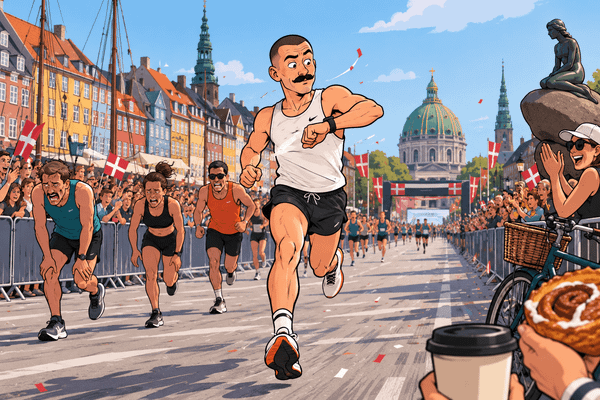
The great thing about running is that you can do it almost anywhere, you’re not relying on a fully equipped gym. If you're visiting somewhere vaguely interesting for work and have almost no sightseeing time between meetings, a run is a great way to see a new place.
Instead of finishing work and spending 45 minutes looking at the inside of the hotel gym, you can see some of the city.
What about food on work trips?
If you're regularly struggling to find food between meetings, throwing a few easy snacks into your bag is considerably simpler than trying to transport a week's worth of meal prep through airport security. There is a difference between maintaining basic nutrition and trying to recreate your home diet perfectly; you do not need seven tupperware containers at Heathrow because you've heard the hotel only serves croissants.
Sometimes the work schedule wins
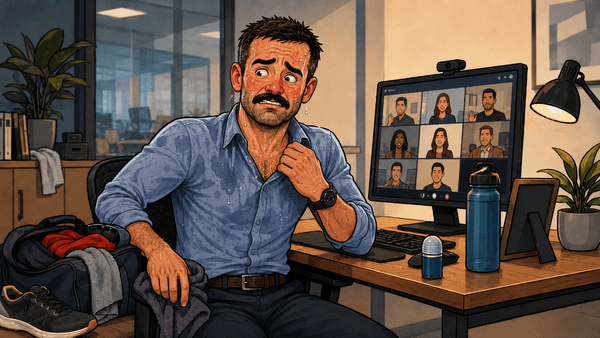
If you've got a 7am breakfast meeting, a full day of work, dinner with colleagues and five hours of sleep behind you, there may not be a sensible training slot hiding somewhere.
You can force one into existence, but that doesn't automatically make it useful. Missing training because you're away for two days is probably preferable to wrecking yourself on a work trip and then spend several days recovering from the inescapable fatigue.
Repeatedly sacrificing every training session because of work is a different problem, but on a short work trip, I don't think you need to win every battle. Sometimes, even just going for a walk is a win.
Training while travelling is about continuity
Training adaptations are built through repeated exposure over weeks and months, and trying to cram several sessions into a reduced window just reduces the recovery time between them. The goal is simply to keep enough movement and structure that travelling doesn't unnecessarily disconnect you from training.
Some trips will simply be twelve hours of work followed by dinner and bed. Others might include a brilliant run through a city you otherwise wouldn't have seen.