Mastering your post-run recovery ritual
Stretching, sleep, a snack, or an ice bath with an app? What post-run recovery needs to do to keep you fit for the next session.

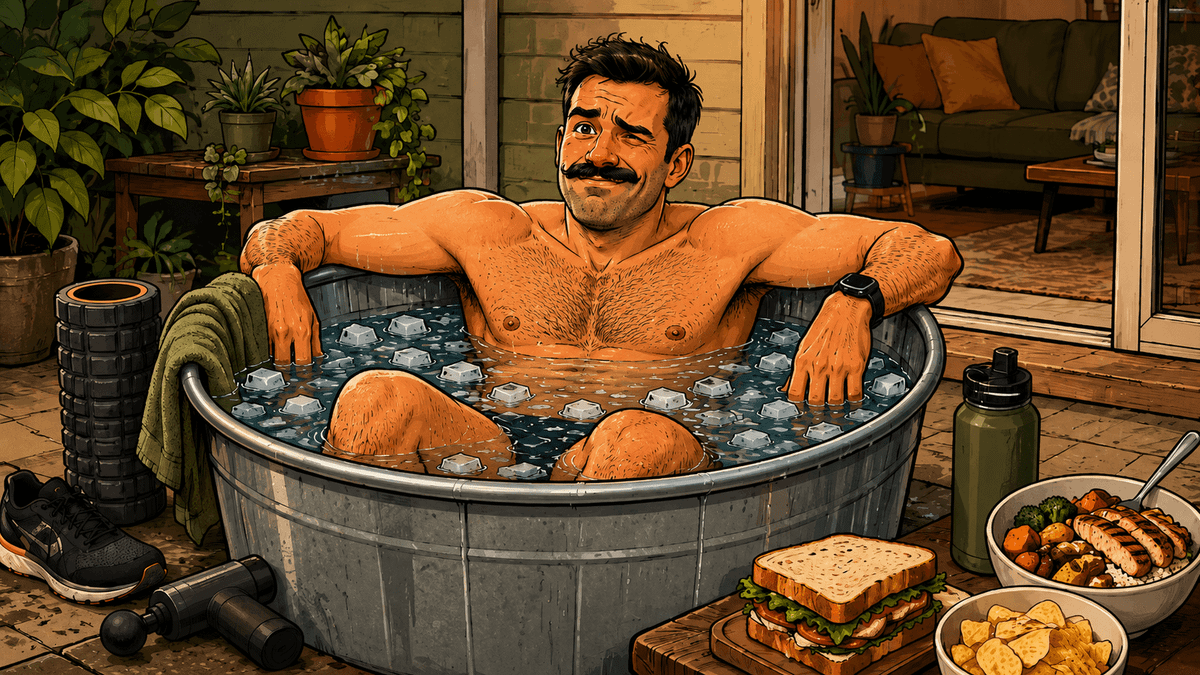
Ask ten runners what "recovery" means and you'll get ten different answers. For one person it's a stretch on the living room floor. For another it's a meal so large it requires a lie-down of its own. Somewhere out there, someone is spending extended time with a massage gun before climbing into an ice bath, and somewhere else, someone else is eating a bag of crisps on the sofa under the name of "recovery" and being entirely correct.
Recovery isn't one ritual with a right answer - it's a handful of separate jobs: refuelling, rehydrating, keeping your muscles workable, and repairing the damage you’ve just done to your body.
What your recovery actually needs
Strip away the marketing and there are four things doing the real work after a run, plus a category of optional extras that get a disproportionate amount of attention for how little they actually do.
Food
What you eat after a run needs to cover two jobs: refilling glycogen (the carbohydrate your muscles store and burn through during exercise) and giving your body the protein it needs to repair the damage a run causes.
You may have heard some version of the "anabolic window": the claim that you have roughly 30 to 60 minutes after finishing to eat, or you'll miss out on the recovery benefits. It's one of the most persistent myths in sports nutrition, but a frequently cited review of the evidence found that the studies which originally seemed to support a strict timing effect had a hidden flaw: the group instructed to eat quickly after training was also simply eating more protein across the full day. Once researchers accounted for total daily protein, the advantage of eating within that narrow window disappeared. Muscle repair runs on a clock measured in hours, not minutes.
Where timing does matter more is glycogen, particularly after a properly long or hard run. If you're training again within a day or so, eating carbohydrate sooner does speed up how quickly that tank refills. So there's a real reason to eat promptly after a long effort — it's just refuelling, not a race against muscle loss.
Which is a roundabout way of saying: reaching for something calorie-dense and easy to eat straight after a long run is the right call for reasons that have nothing to do with a 30-minute deadline.
Hydration
Sweat isn't just water: it carries sodium out with it, and heavier sweaters lose proportionally more. Get that balance wrong on a long, hot run and cramps become more likely, but for most runs, replacing it is simpler than that sounds.
How much you actually need scales with how much you lost, though there's a useful rough marker: losing somewhere around 2% of your body weight in fluid is the point research generally associates with a measurable performance hit, which for most people takes a genuinely long, hot, or hard effort to reach. Drinking to thirst afterwards, with something salty alongside it, covers the vast majority of runs without needing to weigh yourself before and after.
Stretching and mobility
Skip your stretching consistently and chances are that you will start to feel tightness in at least one area. Eventually it will start pulling on tendons and joints nearby, which is how a niggle becomes an actual injury. This gets more relevant with age, the stretching you could get away with skipping in your twenties tends to catch up with you later. If static stretching feels tedious on its own, building it into a broader mobility practice is one way to make it stick.
Delayed onset muscle soreness, or DOMS, is not something stretching reliably prevents. The evidence for stretching stopping soreness is genuinely thin, so if that's the reason you're doing it, it's not really working.
Sleep
This is the one doing the most actual repair, and the one most people cut first when time is tight. Growth hormone release, which plays a central role in tissue repair, peaks during deep sleep, and consistently short-changing yourself on sleep undermines the food, the stretching, and the training itself more than skipping any single recovery ritual does. There's no product that substitutes for this one — it's just a question of protecting the hours.
And if you want to be extra…
Ice baths, compression boots, massage guns — these are the ones with the best marketing and the most mixed evidence. Cold water immersion can genuinely ease short-term soreness and the perception of fatigue, which is a real and legitimate reason to use it occasionally. Where it gets more complicated is if you're using it routinely alongside strength training aimed at building muscle or getting stronger: research has found that regular post-training cold water immersion can blunt some of the muscle-building signalling and long-term strength gains that the training was meant to produce. For a runner using an ice bath after the odd long run, that's not a major concern. For anyone leaning heavily on strength work and icing after every session, it's worth knowing the trade-off exists.
Compression boots and massage guns have less evidence either way. They may be pleasant, sometimes useful to see how a muscle feels, but they’re not doing any actual repair. Use them because you enjoy them, not because you think they're required.
What to prioritise in post-run recovery
Not every run needs the same response afterwards. A long run will deplete you far more than an easy 5k around the park. Glycogen stores are low, sodium losses are higher, and the muscle damage is more substantial, which is why food, hydration, and stretching all matter more urgently than they do after a shorter session. This is where the calorie-dense, salty snack and the proper meal a few hours later are doing real work, not just feeling nice.
Short, tempo, and interval sessions are a different profile. The depletion is smaller, so there's less urgency around eating or drinking immediately — a normal meal at a normal time covers it. What matters more here is next-session readiness: these sessions are often run closer together in a training week, so sleep and not skipping stretching "because it was only a short run" are what keep the next hard session from being compromised by a tightness that didn't get addressed.
Signs you need a recovery day
A genuine recovery day isn't just "the day I didn't run" — it's a day where the things above; food, sleep and hydration; are actually prioritised rather than an afterthought once life gets in the way.
If you’re noticing persistent fatigue that doesn't lift after a normal night's sleep, a resting heart rate that's noticeably higher than usual, a heart rate that takes longer than normal to settle after effort, or motivation that's gone flat rather than just reluctant: it is probably a sign it’s time for a recovery day. Any one of these on its own may be nothing, but several stacking up across a week is the body asking for the thing you've been putting off.
Speeding recovery up isn't a separate trick — it's doing the four basics properly rather than searching for a shortcut around them. Sleep more, eat enough protein and carbohydrate, replace sodium if you've been sweating heavily, and stretch the areas that are tightest. The extras can sit on top of that if you enjoy them, but they can't replace it.
Do you really need a post-run recovery ritual?
Training only works because recovery happens in between it, and there's a limit to how long you can skip that part before it starts skipping you back. It doesn't need to be complicated, and it definitely doesn't need an app. It just needs doing — so you may as well make it the bit of the day you actually enjoy.
FAQ
Do I need a protein shake after every run?
No. A shake is a convenient way to hit a protein target, not a requirement. If a snack and a proper meal within a few hours cover your protein for the day, you've done the job just as well.
Is a cold bath better than a warm one for recovery?
For occasional use after a long run, either is fine — pick whichever you prefer.
Do I need electrolyte tablets, or is a salty snack enough?
For most runs, a salty snack and a normal diet cover it. Electrolyte tablets earn their place on longer, hotter efforts where sweat losses are heavier and harder to replace through food alone.
What actually counts as a rest day?
A day where training load drops and the basics (sleep, food, hydration) are treated as the priority rather than an afterthought — not just a day without a run logged.