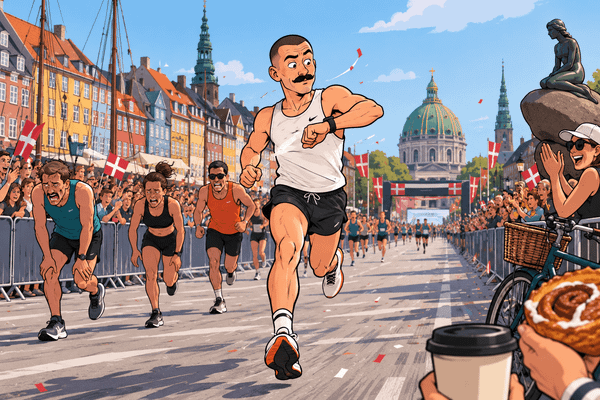
Runner's shits: why you need a poo mid-run and how to stop it
Runner's stomach explained: why it happens, what triggers it, and how to get through a long run without scanning every hedgerow.

Birds, in their infinite biological wisdom, defecate on take-off. Every gram shed before flight is a gram not carried through the air: weight is the enemy of speed.
To achieve great heights, one must first lighten the load.
Except you are three kilometres into a Sunday long run and suddenly very aware of your lower abdomen, and you can’t just shit in places and then fly off.
Why running makes you need the toilet
When your body shifts into fight-or-flight — which is essentially what hard running signals to your nervous system — it does several things simultaneously.
- It diverts blood away from your digestive system towards your working muscles, heart, and lungs. Your gut, now relatively starved of circulation, becomes less able to continue the quiet, orderly business of digestion it was getting on with before you decided to go running.
- Running introduces sustained mechanical jostling. That repeated motion stimulates the colon wall directly. And the colon, when stimulated, has a limited and fairly committed range of responses.
- Clearing your gut before intense physical effort makes you lighter and faster - at least that’s the evolutionary reading. The theory is plausible, but harder to prove than the physiology underneath it.
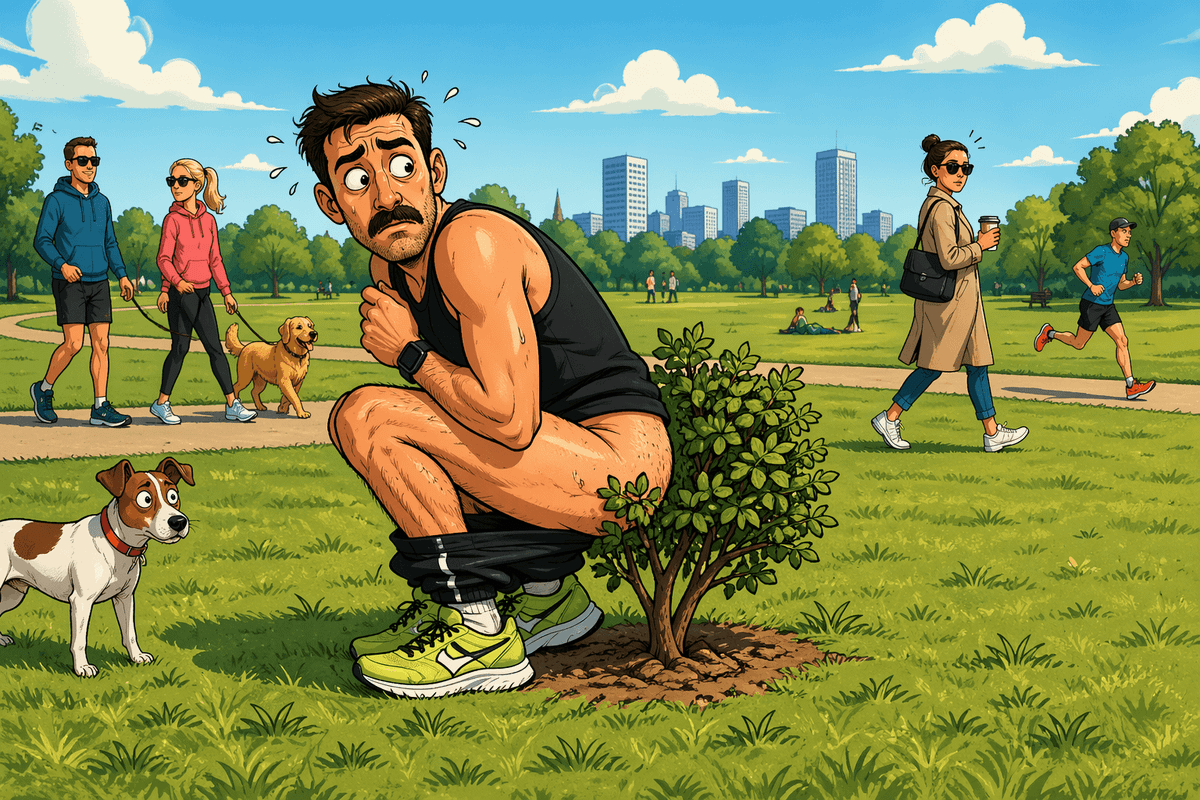
The result, either way, is you urgently scanning the park, which suddenly turned into an enormous open space with very few plants and a lot of passers by, for somewhere to disappear behind.
The pre-run foods most likely to make you need the toilet
The gut is already working under duress during hard exercise. What you put in it beforehand, and how recently, determines how badly that goes:
- High-fat foods slow gastric emptying, which means anything rich eaten within two to three hours of a run may still be mid-process when you set off.
- High-fibre foods like rye bread and wholemeal flour stimulate gut motility, which is useful for everyday digestion but entirely unwelcome at tempo pace.
- Spicy food irritates the gut lining directly.
- Dairy causes issues for a significant proportion of the population who have partial lactose intolerance they've simply never investigated.
- Fructose, found in some energy gels and sports drinks, draws water into the intestine and moves through the gut quickly in ways that do not combine well with running at any serious effort.
The food that sets you off will be entirely personal: I’ve been absolutely fine running an hour after a curry but the closest I’ve been to shitting my pants in public came from a slice of cheese pre-run.
How to not shit yourself on your next run
Use caffeine as a pre-run toilet strategy
A strong coffee first thing in the morning, particularly the first coffee of the day when that reflex is at its most active, reliably moves things along. Used deliberately, this means the colon has done its job before you leave the house rather than three kilometres into a park.
There are still risks involved: if caffeine doesn't reliably move things along within a predictable window for you, using it as a pre-run clearing strategy is a gamble that I personally wouldn’t bet my dignity on.
Give yourself enough time before you leave
Eating or drinking sends a signal to the colon to clear itself out — an efficient system that runs on its own schedule rather than yours. The problem is that many runners set an alarm for as late as possible, eat quickly, and head out before the reflex has had time to do anything useful.
Giving yourself thirty to forty-five minutes after eating and drinking before you run is enough for most people, but not for all of us. Personally, anything under one hour is asking for trouble and two hours is my safe space.
Reduce the intensity
The harder you run, the more blood your muscles demand, and the more aggressively your body takes it from the gut. If you're having regular problems mid-run, the first question worth asking before you overhaul your diet is: how hard am I actually running? Many runners who struggle on long runs are going harder than they think, particularly in the early kilometres before fatigue enforces sensible pacing.
Genuinely easy running — conversational pace, comfortable breathing — doesn't demand enough from the cardiovascular system to trigger severe gut blood-flow diversion.
Control the bounce
Every time your foot hits the ground, the impact travels upward. If you're bouncing a lot, that impact is reaching your abdomen on every stride, for however many thousands of strides you take on a long run. Your colon, which is not bolted in place, feels all of it. Running smoother isn't just more efficient. It's also less likely to agitate your insides.
Imagine a ceiling six inches above your head and run as if hitting it would be expensive. The goal is to drive forward rather than upward — to put energy into horizontal movement rather than bouncing through the air. The ceiling cue tends to shorten ground contact time and reduce the exaggerated up-and-down motion.
Why do I only get runner's shits on race day?
Race day concentrates every trigger simultaneously: higher intensity than training, pre-race nerves, often earlier than usual eating and rushed pre-run routines, and sometimes unfamiliar food or gels. It is not that your gut is uniquely rebellious on race day. It is that race day creates ideal conditions for all the triggers to hit at once.
Does runner’s stomach get better as you get fitter?
Broadly, yes. Trained runners show less severe gut blood-flow diversion at the same relative effort level, because their cardiovascular system is more efficient at the job. It doesn't mean you can ignore everything above, but it does mean that consistent training is doing work on the problem in the background.
Are some people just more prone to it?
Yes. Runners with Irritable Bowel Syndrome (IBS) or functional gut disorders experience exercise-induced GI symptoms at higher rates than the general running population. Women are statistically more affected than men. If you've addressed all the practical factors and the problem is severe or consistent, it's worth discussing with a GP rather than treating it as a training problem to solve alone.