
Is it iron deficiency or are you just bad at running?
Heavy legs, slipping times, fatigue that rest doesn't fix — iron deficiency produces a near-perfect imitation of overtraining. Here's why runners are at risk and what to do.

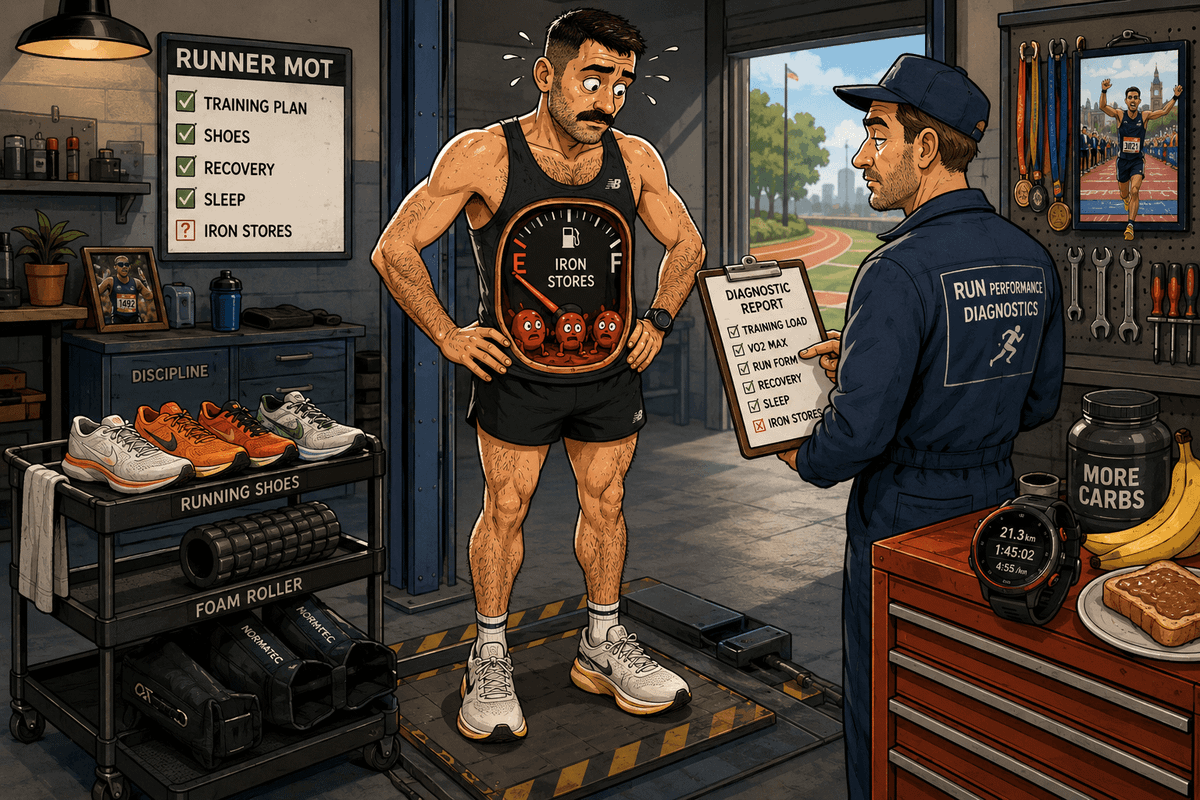
If you've had a training block where everything was going wrong — legs that never quite recovered, easy runs feeling harder than they should — there's a good chance you blamed the training and wondered if you were overreaching. Iron deficiency produces a near-perfect imitation of overtraining, which is precisely why it gets missed.
There is no obvious signal; the body compensates quietly while performance degrades gradually, and the most natural explanation is always training load rather than nutrition. By the time most runners get tested, they've been running on depleted stores for months.
Why running depletes iron
Iron's primary job is to carry oxygen in the blood. When iron is low, oxygen delivery is impaired, the muscles work harder for the same output, perceived effort rises, and performance drops in a way that feels frustratingly non-specific.
Running depletes iron through several mechanisms that don't apply to most other sports.
Foot-strike haemolysis is the most specific and the least discussed. With every footstrike, the small blood vessels in the soles of the feet are compressed and the red blood cells inside them are physically destroyed by the impact. The body replaces them — red blood cells have a lifespan of around 120 days — but high mileage accelerates the turnover rate and increases iron demand considerably. Softer surfaces and well-cushioned shoes reduce it but don't eliminate it.
Sweat contains iron in small but meaningful amounts, particularly during high-volume training in warm conditions. Not dramatic in isolation, but it compounds with everything else.
Hard running also causes minor bleeding in the gastrointestinal tract — small enough to be invisible, significant enough to contribute to iron loss, particularly at higher intensities.
Then there's hepcidin — the mechanism most runners have never heard of. After exercise, the body releases a hormone that temporarily suppresses iron absorption from food, apparently as a protective response against infection (bacteria also need iron to survive). Eating your iron-rich meal in the evening after a morning run, rather than immediately post-session, sidesteps some of this.
Female runners carry significantly more risk of iron deficiency
Everything above applies to all runners. Women have one additional and substantial source of iron loss: menstruation. Monthly blood loss on top of training-related losses puts female endurance athletes at high risk — some studies estimate 30 to 50% of female runners in heavy training have depleted iron stores at any given time. It is one of the most common and most under-diagnosed nutritional deficiencies in women's sport.
This doesn't mean male runners are immune. A male runner doing high mileage on a predominantly chicken-and-fish diet, training through summer, is not in a risk-free position. But women need to treat iron as a nutrient requiring active management rather than passive assumption.
What does ferritin have to do with iron deficiency in runners?
The standard blood test for anaemia measures haemoglobin — the iron-containing protein in red blood cells. But haemoglobin only drops when iron deficiency is severe. Before that point, the body draws down its iron stores — measured by a marker called ferritin — while keeping haemoglobin in the normal range. A runner can have a normal haemoglobin result, be told everything is fine, and still be running on significantly depleted stores that are impairing their performance.
If you're asking for a blood test because you suspect iron issues, ask specifically for ferritin. A result above 12 micrograms per litre is technically "normal" by clinical standards. Most sports medicine practitioners consider anything below 30–40 suboptimal for an endurance athlete, and some target above 50. The clinical floor and the performance floor are not the same number.
What to do about iron deficiency as a runner
Iron supplements are not like vitamin D supplements where the worst case of over-supplementing is mildly embarrassing. Excess iron accumulates in organs and causes damage that isn't quickly reversible. Supplementing without confirmed deficiency carries real risk. Get a blood test, ask for ferritin specifically, and act on the result.
If you're not deficient, focus on dietary sources. Haem iron — from red meat, liver, and dark poultry — is absorbed at around 15–35%. Non-haem iron — from plant sources, eggs, and fortified foods — is absorbed at 2–20%, with significant variation depending on what you eat alongside it. Vitamin C substantially increases non-haem iron absorption; pairing it with your iron-rich meal costs nothing and makes a meaningful difference. Conversely, calcium and the tannins in coffee and tea inhibit absorption — worth knowing if your post-run routine involves a flat white with your eggs.
Performance that degrades without explanation is worth investigating rather than training through. Most runners reach for a training fix when the answer is a blood test and a steak. Before you conclude you're just bad at running, check your ferritin.
If you are deficient, follow medical guidance on supplementation. How much and for how long depends on the degree of depletion and is better managed with a GP or sports dietitian than a label recommendation.