
Protein for runners: how much you need and when
Most runners don't eat enough protein and can't feel it until they fix it. How much, when it actually matters, and how to track it without losing your mind.

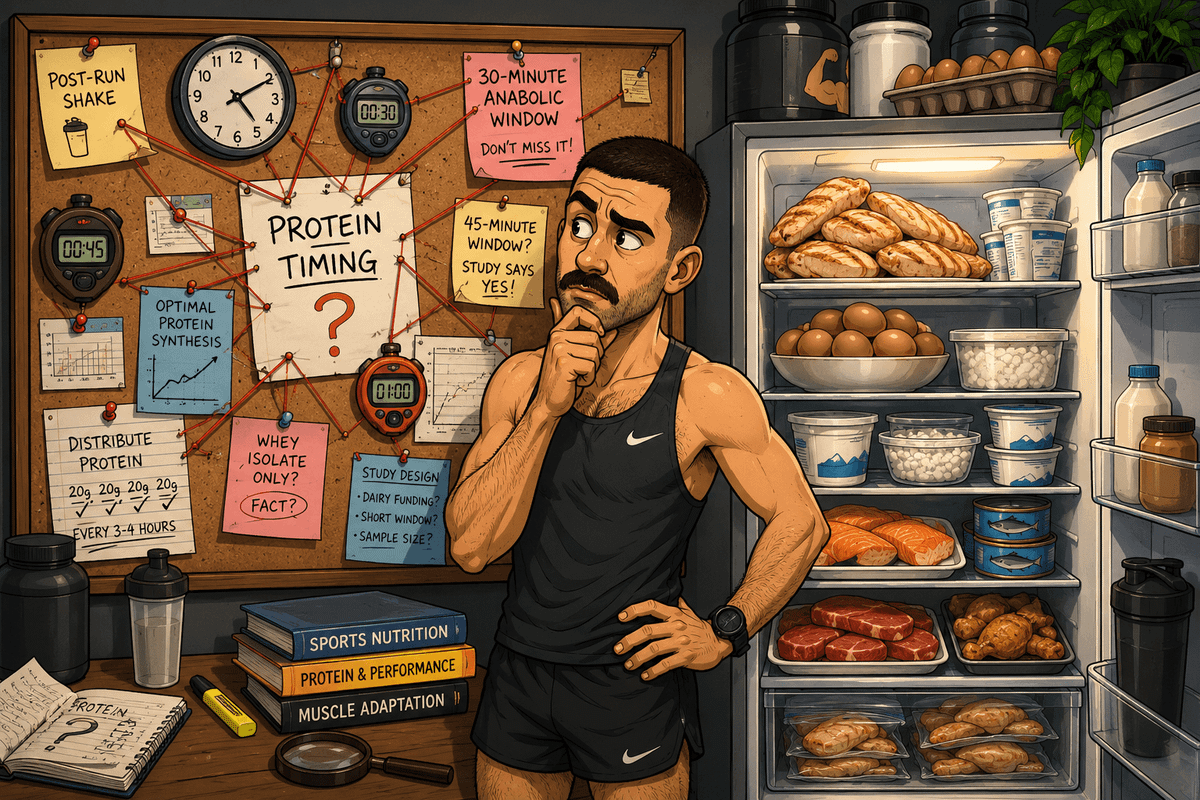
The problem with not eating enough protein is that it doesn't feel like a problem. The fatigue after long runs is normal, and recovery taking a day longer than it should feels normal. Sleeping slightly worse than you'd like is normal. There is no warning sign that your diet is too low in protein, you simply have a baseline that is sub-optimal that you might be so used to it feels mostly fine.
When you increase protein intake properly and consistently, something shifts within a few weeks: recovery is faster, sleep is noticeably better, and training feels less like managing a slow accumulation of damage.
Why runners need more protein
Every long run, every tempo session, every set of hill repeats causes microscopic damage to muscle fibres, and the body repairs and rebuilds them slightly stronger. That repair process requires protein as the raw material. Without adequate supply, the adaptation is slow or incomplete.
Chronic under-eating of protein doesn't cause an immediate problem; it creates a background drain on the repair process that tends to show up as persistent niggles that won't quite resolve.
How much is actually enough
The Recommended Dietary Allowance (RDA) for protein is 0.8 grams per kilogram of body weight per day. Unlike other RDA values like saturated fat and salt, this is the minimum required: the 0.8 grams per kilogram of bodyweight comes from starvation studies in the Warsaw ghetto in World War II and should be treated as the absolute floor.
For endurance athletes in meaningful training, the current evidence points to somewhere between 1.6 and 2.0 grams of protein per kilogram of body weight per day.
The more useful number is what you're currently eating — which is almost certainly less than you think. What starts as a 70g portion of pasta becomes 100 grams, then 150 grams, over a few months of eyeballing it. The same drift happens in reverse with protein sources: you think you're eating what you were eating six months ago. You're probably not.
Periodic tracking — two weeks every few months, rather than a permanent daily log — is enough to recalibrate. You don’t want to count protein forever, but it’s useful to check whether your intuition still matches reality.
Why protein timing is mostly a distraction
Older guidelines suggested a ceiling of around 30 grams of protein per meal. The studies behind this recommendation were largely conducted using whey protein, frequently with dairy industry funding, and ran for measurement windows of three to five hours — a design that happens to be perfectly suited to demonstrating the value of a 30-gram serving every few hours. A 2023 study by Trommelen et al. measured over 12 hours instead and found the body was still actively using protein well beyond the point where earlier studies had stopped looking.
So in summary: if you want to hit 200 grams of protein in one sitting, the evidence suggests your body will deal with it. I’m not sure my gut could cope with that volume of food, but if you try it I’d love to hear how you get on.